
When History Meets Mission: How One Catholic University Rediscovered the Real St. Clare
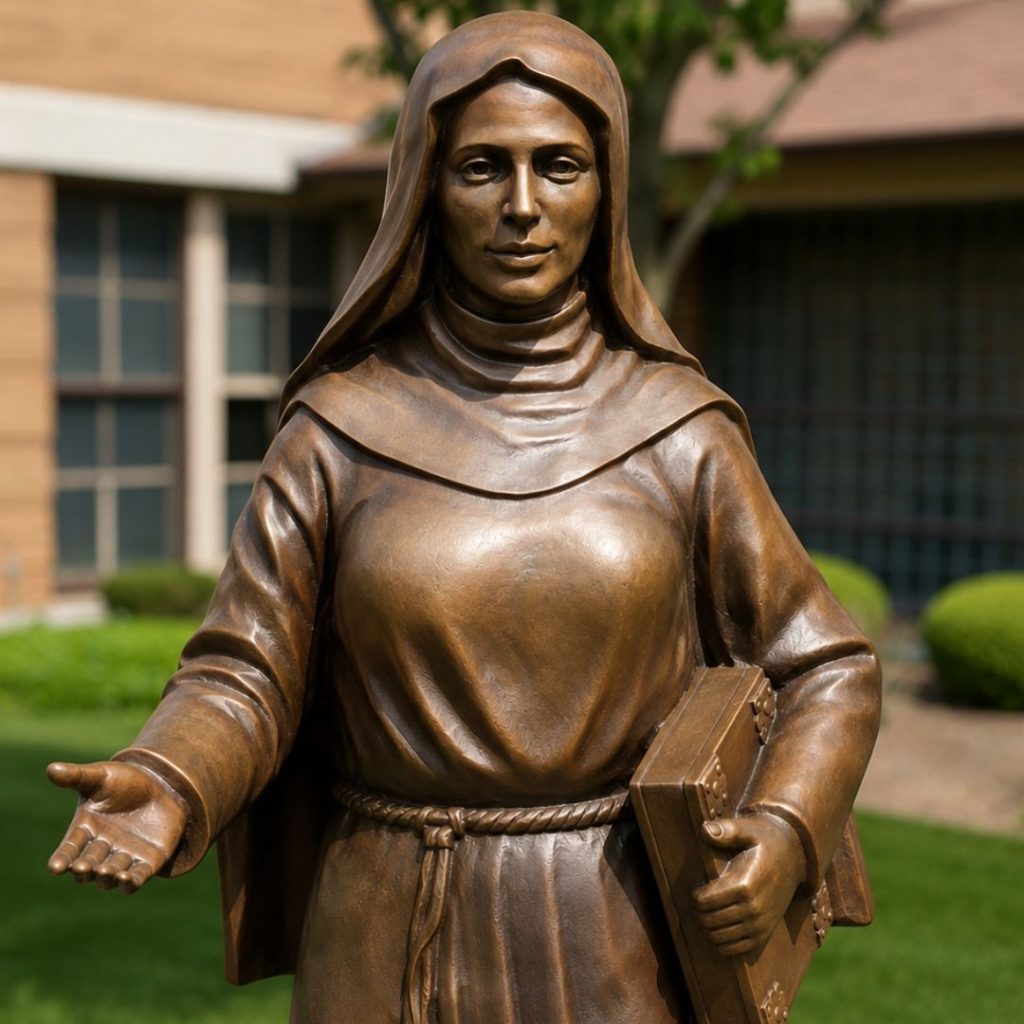
Looking beyond familiar devotion to encounter the woman who helped shape Franciscan history Walk through almost any Catholic church or browse a catalog of devotional art, and the image of St. Clare of Assisi is immediately recognizable. She is often shown beside St. Francis or holding a monstrance, recalling the beloved tradition of her courageous defense of San Damiano through her faith in Christ present in the Eucharist. These images have inspired generations of Catholics and remain deeply rooted in the Church’s devotional life. From her welcoming gesture to the manuscript she carries, the sculpture reflects extensive historical and theological research. Rather than inventing a new image of Clare, the design seeks to recover dimensions of her life that are often less familiar today. Yet every saint is larger than the moment for which history most readily remembers them. When the University of St. Francis in Joliet, Illinois, began exploring a new St. Clare of Assisi statue for its St. Clare Campus, the conversation quickly moved beyond a familiar question of style or appearance. Instead, university leaders asked something far more fundamental: Who was the real Clare? If students encountered her every day outside Guardian Angel Hall, what would they learn about her life, her vocation, and her example? That question transformed the project from simply selecting a statue into an exercise in historical research, theological reflection, and institutional identity. It also illustrates something important about the process to commission religious sculpture. At its best, original sacred art is not an attempt to create something novel. Rather, it seeks to recover truths that deserve to be seen with fresh clarity. St. Clare’s friendship with St. Francis and her profound Eucharistic devotion remain essential parts of her story. But the university recognized that these well-loved aspects of her life are only part of a much richer legacy. Long before history remembered her as a companion of Francis, Clare had become a founder, an abbess, a spiritual teacher, and one of the most influential women of the medieval Church. She guided her community for more than four decades through extraordinary political, ecclesial, and social challenges. Women traveled to San Damiano seeking her wisdom. Popes corresponded with her. She exercised remarkable leadership while embracing radical humility. Perhaps most significantly, Clare became the first woman to write a monastic rule for women that received formal papal approval. Her Rule of St. Clare did far more than govern daily life within a convent. It articulated a distinctly Franciscan vision of poverty, prayer, fraternity, and joyful dependence upon God. More than eight centuries later, it continues to shape communities around the world. For a Catholic university, that achievement carried profound significance. Universities exist to form minds as well as hearts. They celebrate scholarship, intellectual inquiry, and the transmission of wisdom across generations. Presenting Clare simply as a figure of private devotion would have overlooked one of history’s most remarkable examples of female leadership, theological insight, and institutional vision. Her written Rule became not merely a historical document but a lasting contribution to the life of the Church. That realization naturally shaped every artistic decision that followed. Rather than beginning with the question, “What should she hold?” the design process began with another question: “What best represents the historical Clare?” The answer was not a symbolic object added for visual interest. It was the Rule itself. The manuscript represents the Rule of Life that Clare composed for her sisters—the first monastic rule written by a woman for women to receive papal approval. For a Catholic university, it symbolizes scholarship, wisdom, leadership, and the enduring relationship between faith and learning. In the finished Franciscan sculpture, Clare gently carries a medieval manuscript representing the Rule of St. Clare. It immediately identifies her as a teacher, an author, and a woman whose faith found expression not only in prayer but also in thoughtful leadership. For students entering classrooms every day, the manuscript becomes a quiet reminder that intellectual achievement and deep holiness are never opposed. Learning itself can become an act of discipleship. That symbolism is particularly fitting within a university environment. Books represent the pursuit of truth. Clare’s manuscript represents truth placed at the service of human flourishing. It reminds students that authentic leadership begins not with authority but with wisdom. Her other hand extends outward in a simple gesture of welcome. It is neither theatrical nor sentimental. Instead, it reflects the Franciscan spirit of hospitality that marked Clare’s life. Throughout her years as abbess, San Damiano became a place where others found encouragement, prayer, and peace. The open hand quietly invites students, faculty, visitors, and patients alike into that same spirit of welcome before they even enter the building behind her. Even details that many observers may never consciously notice contribute to telling Clare’s story faithfully. She stands barefoot. In medieval Italy, bare feet spoke not of poverty alone but of voluntary simplicity and humility. They reflect a woman who intentionally embraced a life stripped of status and privilege in order to follow Christ more completely. The absence of elaborate footwear says as much about Clare’s values as any written inscription could. Around her waist rests the familiar Franciscan cord with its three knots representing poverty, chastity, and obedience. While immediately recognizable within Franciscan spirituality, it also reminds viewers that Clare’s leadership flowed from vows freely embraced rather than power acquired. Her authority emerged from fidelity. The sculpted manuscript itself resembles a genuine medieval volume rather than a modern book. Its proportions, binding, and presentation subtly reinforce the historical setting of Clare’s life. The goal was never archaeological reconstruction for its own sake but historical authenticity placed in the service of theological truth. Perhaps the most challenging artistic decision involved her face. History offers no portrait of Clare painted from life. Every artist must therefore interpret her appearance. Yet interpretation carries responsibility. Rather than creating an idealized figure detached from history, the sculpture presents Clare as recognizably Italian, youthful yet mature, attractive without romanticizing her features. Her