
Beyond the Religion Classroom: 8 Ways Sacred Art Can Become a Teaching Tool in Catholic Schools
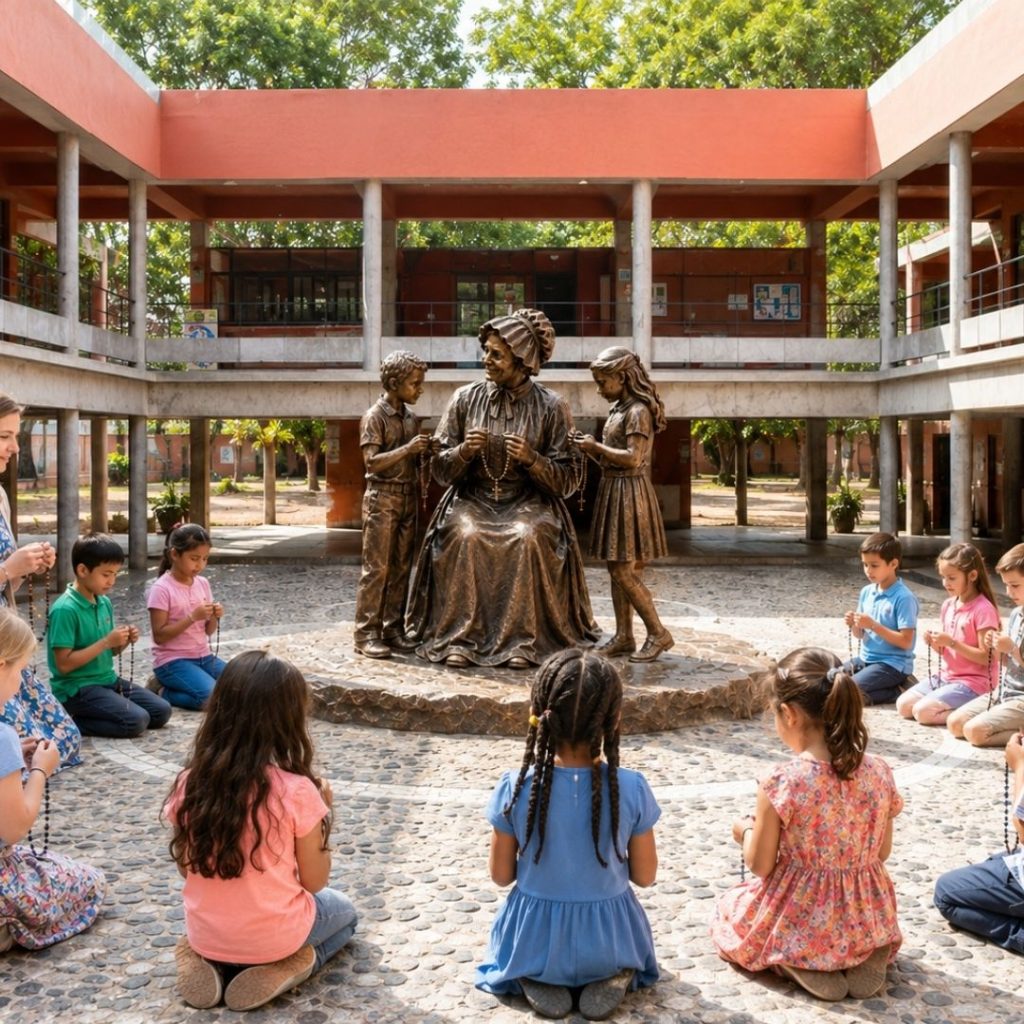
Sacred art can do more than establish Catholic identity. When thoughtfully chosen and intentionally used, it can help students encounter Scripture, understand the saints, learn Catholic theology, and develop a life of prayer. Walk through almost any Catholic school and you will find visual reminders of the faith: a crucifix in every classroom, an image of Mary, perhaps a statue of the school’s patron saint. These objects help distinguish a Catholic school from any other educational environment. They tell students, families, and visitors something important about the identity of the institution. But sacred art has the potential to do something more. A sculpture can become a teaching tool. When students are encouraged to look closely at sacred art—to notice a gesture, identify a symbol, consider why a saint is holding a particular object, or connect a composition with Scripture—the artwork becomes another way of teaching the Catholic faith. A courtyard, entrance, prayer garden, or hallway can effectively become an extension of the religion classroom. For Catholic schools investing in sacred art, this presents an important opportunity. Instead of asking only, “What would look beautiful here?” or even “What represents our Catholic identity?” schools can ask a third question: What could our students learn from this? That question can influence everything from the saint or biblical subject selected to the symbolism incorporated into a Catholic school sculpture. Here are eight ways sacred art can become part of the educational mission of a Catholic school. 1. Make Scripture Something Students Can See Children encounter Scripture differently when they can see a biblical passage expressed in three dimensions. Consider the Good Shepherd. Students may know Psalm 23 and hear Christ’s words in John 10: “My sheep hear my voice; I know them, and they follow me.” But a Good Shepherd sculpture gives teachers another way to explore those words. Why is Christ calling? Why does He have His hand on one sheep? Why are other sheep near the water? What does it mean for the sheep to recognize the shepherd’s voice? Questions like these encourage students to move beyond memorizing a passage and begin interpreting it. The same principle can apply throughout a Catholic school campus. A sculpture of Christ welcoming children, the Holy Family, the Visitation, the Good Samaritan, or another biblical scene can provide a physical starting point for Scripture lessons. Teachers can even take students outside with the biblical text in hand. Read the passage. Study the sculpture. Then ask students what the artist chose to emphasize—and what that might reveal about the Scripture they have just heard. Suddenly, the school grounds have become a biblical classroom. 2. Teach Students How to “Read” Catholic Art Catholic sacred art has always used visual symbols to communicate meaning. Yet students will not necessarily understand that language unless someone teaches them how to recognize it. Why does St. Peter carry keys? Why is St. Joseph associated with lilies? Why might a martyr hold a palm? Why do Franciscan saints wear a cord containing three knots? The symbols are not arbitrary decoration. They tell stories. This is particularly valuable when a school commissions custom religious sculpture, because the symbols can be selected intentionally for the lessons the institution hopes to communicate. Carlo Acutis provides an excellent contemporary example. A sculpture might include his laptop, Rosary, contemporary clothing, or references to his devotion to the Eucharist. Students can begin with objects they immediately recognize and then investigate what those objects reveal about his life and spirituality. Teaching children to read sacred art also gives them a Catholic visual vocabulary they can carry elsewhere. The next time they visit a cathedral, basilica, museum, shrine, or historic church, they begin noticing details that previously would have gone unseen. 3. Make the Communion of Saints Understandable The Communion of Saints can be a difficult concept for children. A patron saint sculpture can help make it concrete. This was an important idea behind Indweller Artistic’s depiction of St. James the Apostle with schoolchildren. Rather than portraying the saint entirely by himself, the composition places children within the protection of his fishing net. The imagery creates an opening for catechesis. Who is St. James? Why is he associated with a fishing net? Why are the children inside it? Why would a Catholic school have a patron saint at all? From there, a teacher can introduce a much larger Catholic idea: saints are not simply admirable historical figures whose biographies we study. Catholics believe they remain members of the living Church and intercede for us. For children, the image of their patron gathering them within his net can make that relationship understandable in a way a definition in a textbook may not. It also prevents a patron saint from gradually becoming little more than the school’s religious mascot. The artwork can remind students what patronage actually means. 4. Introduce Students to Catholic Role Models Catholic schools have an extraordinary educational resource available to them in the lives of the saints. Their stories encompass courage, intellectual achievement, sacrifice, leadership, mercy, perseverance, service, conversion, and fidelity. Sacred art gives those stories faces. Pope Francis, for example, offers Catholic students much more than a historical connection with Catholic education. His life can introduce conversations about vocation, service, adversity, social justice, leadership, and the tremendous impact one person can have on generations that follow. St. Josephine Bakhita offers another powerful example. Her story can open age-appropriate conversations about human dignity, freedom, forgiveness, suffering, and the inherent worth of every person. And Carlo Acutis gives students a saint from a world much closer to their own—a young person who used computers, wore ordinary clothes, had friends and interests, and nevertheless placed the Eucharist at the center of his life. The lesson is not simply, “These were holy people.” It is that holiness has taken many forms in many different lives—and remains possible now. 5. Connect Virtue with a Person and a Story Schools spend considerable time teaching values such as compassion, courage, honesty, perseverance, hospitality,