
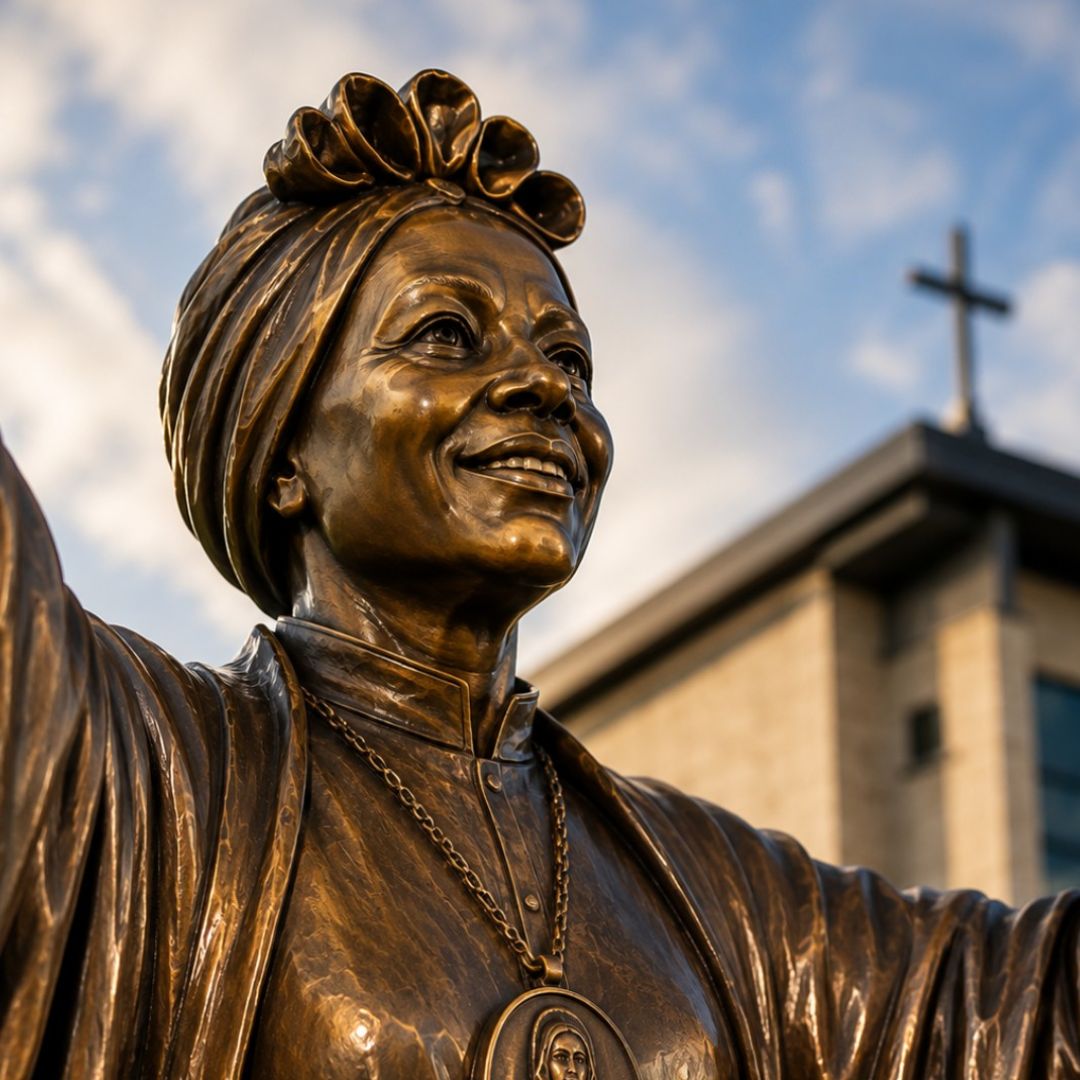
A patron saint can give a Catholic institution more than a name. St. Josephine Bakhita’s remarkable journey from enslavement to freedom offers a powerful witness to human dignity, resilience, forgiveness, hope, and the transformative power of faith.
Choosing a patron saint for a Catholic school, university, parish, ministry, or Catholic organization can seem straightforward. Find a beloved saint whose virtues reflect the organization, adopt the name, and move forward. But the best choices go much deeper.
A patron saint is not simply a recognizable Catholic name attached to a building or organization. A patron can help express an institution’s Catholic identity, history, mission, community, and aspirations. The saint’s life can become part of the culture of the institution—appearing in prayer, religious education, campus traditions, sacred art, feast-day celebrations, and even in the way students or parishioners understand their own calling.
For an existing institution, the question may be slightly different. The patron may have been chosen generations ago, and few people currently attending the school or parish may know much about the person behind the name. In that situation, the opportunity is not to choose a new patron, but to rediscover the one the community already has.
Whether choosing a patron for the first time or bringing an established namesake back to life, the most important question is not simply, Which saint is most familiar? A better question is: Whose story speaks to who we are—and who we are called to become?
What Does a Patron Saint Mean to a Catholic Institution?
In Catholic tradition, a patron saint is a heavenly intercessor associated with a person, place, profession, community, or particular need. For a Catholic institution, patronage has an additional dimension. The saint can provide a spiritual identity around which the community gathers.
A school named for St. James, for example, does not have to treat James merely as the historical figure whose name appears on the sign outside. Students can learn about the apostle, celebrate his feast day, ask for his intercession, and come to understand why his life matters to their own school community.
A Franciscan university may look to St. Francis, St. Clare, or another figure from the Franciscan tradition when articulating its educational mission. A Catholic school might find in St. Elizabeth Ann Seton an especially powerful expression of the relationship between education and faith. A young adult ministry may discover in St. Pier Giorgio Frassati a patron whose friendships, active life, service to the poor, and joyful Catholic faith speak directly to the people it serves.
This is why choosing a Catholic patron saint deserves discernment rather than simply selecting a familiar name from a list.
Start With the Institution’s Catholic Mission
One of the best places to begin is the institution’s own mission statement. What is this community trying to accomplish? What qualities does it hope to form in the people it serves?
A Catholic university might emphasize intellectual inquiry, service, human dignity, or the charism of the religious community that founded it. A Catholic school may focus on educating young people academically while forming them spiritually. A parish may have a particularly strong tradition of hospitality, Eucharistic devotion, evangelization, outreach, or care for marginalized people.
Then consider saints whose lives embody those same values. This creates something much stronger than a superficial association. The saint becomes a human expression of the institutional mission.
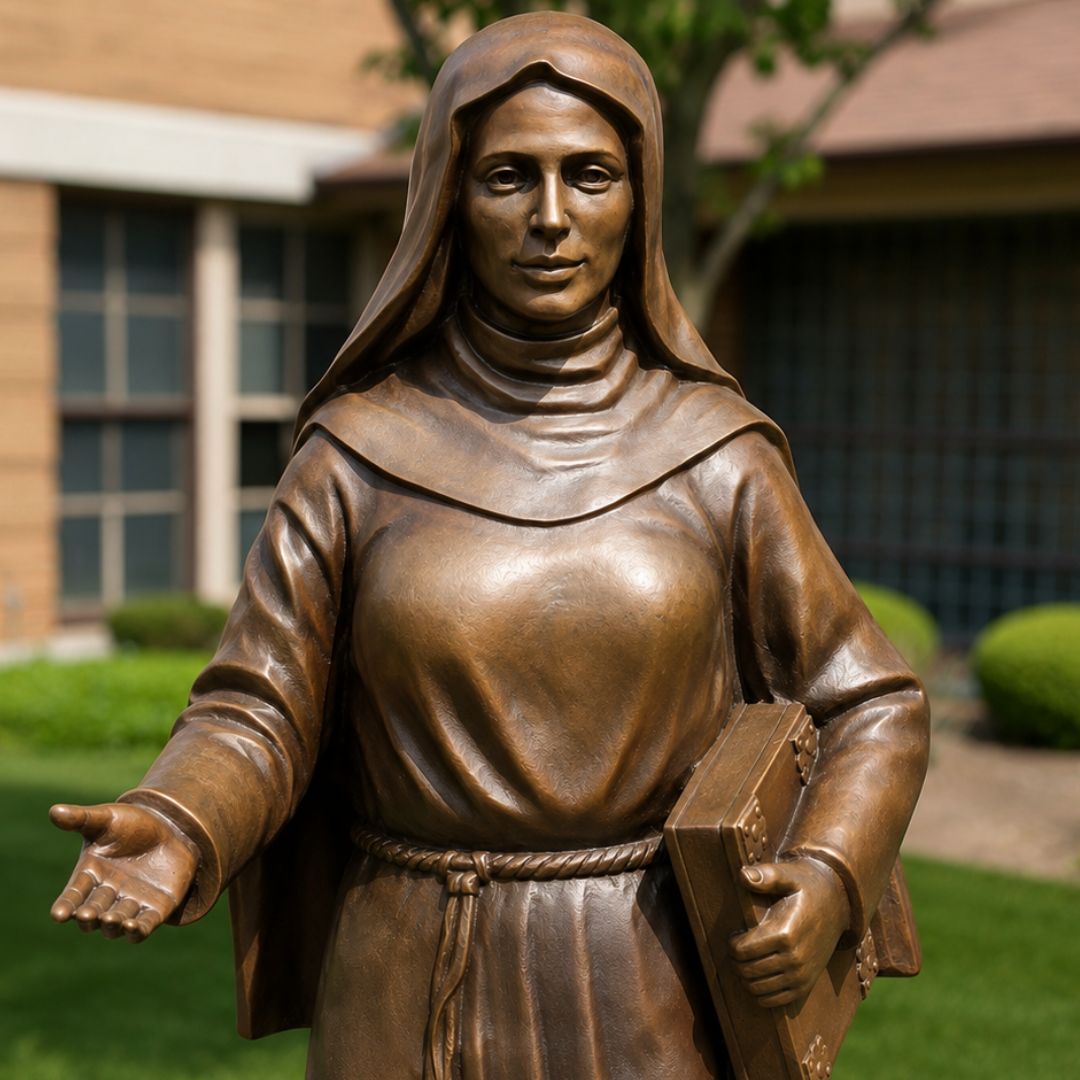
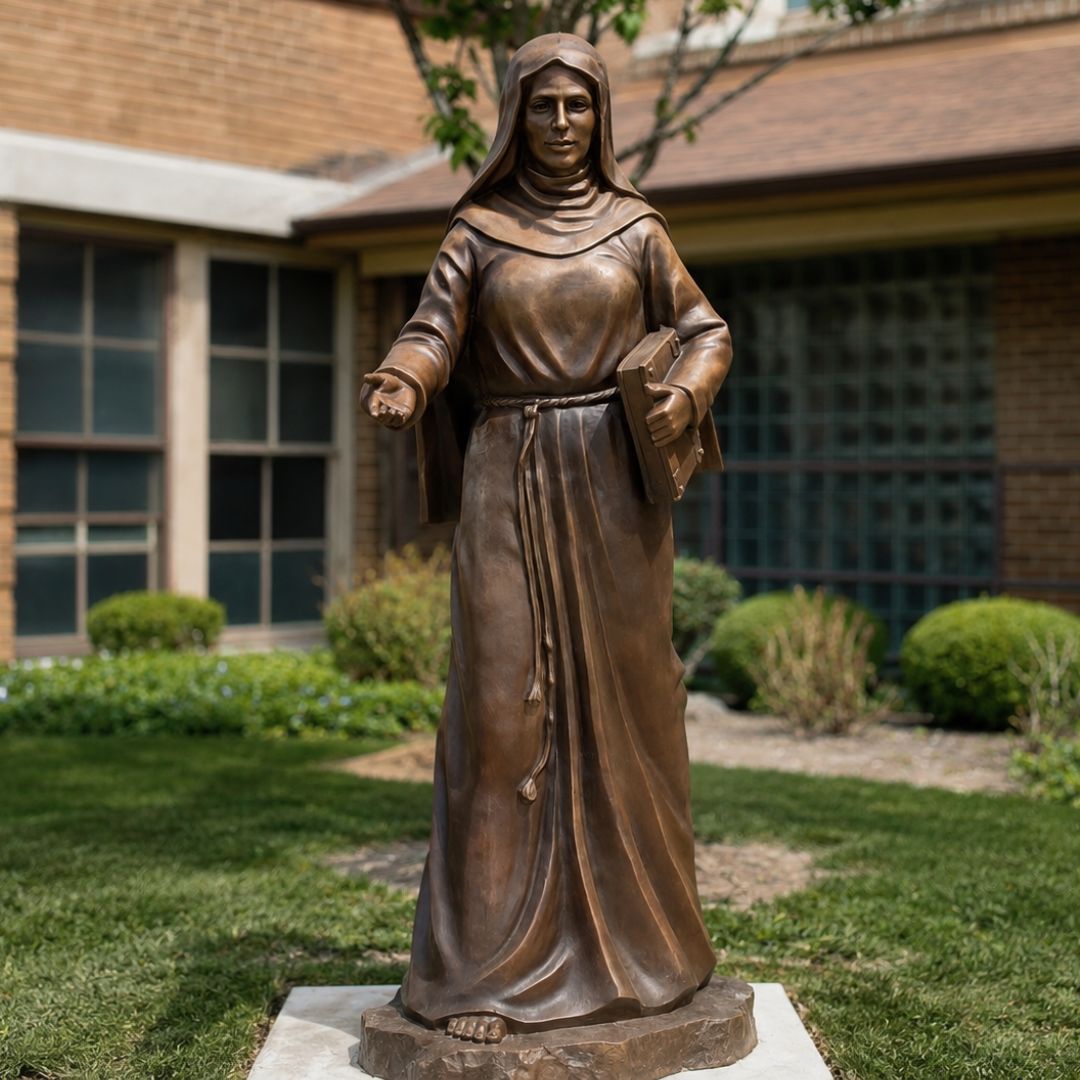
That principle became particularly important in an Indweller Artistic project involving St. Clare of Assisi at the University of St. Francis in Joliet, Illinois. The university wanted its representation of Clare to communicate something important about the historical woman: her faith, intelligence, courage, and leadership.
The sculpture therefore incorporates a medieval book representing her Rule of Life. It is a relatively simple artistic detail, but it changes the way the viewer encounters Clare. The symbolism connects an influential woman of the 13th century with a modern university devoted to education, formation, and the Franciscan tradition. The sculpture does more than identify St. Clare. It helps explain why Clare belongs there.
A Patron Saint Can Embody the Entire Mission of Catholic Education
Perhaps nowhere is the relationship between patronage and institutional mission clearer than in Catholic education.
St. Elizabeth Ann Seton is a foundational figure in the history of Catholic education in the United States. But simply placing a conventional statue of Seton outside a Catholic school does not necessarily communicate why her life matters to the children walking past it every morning.
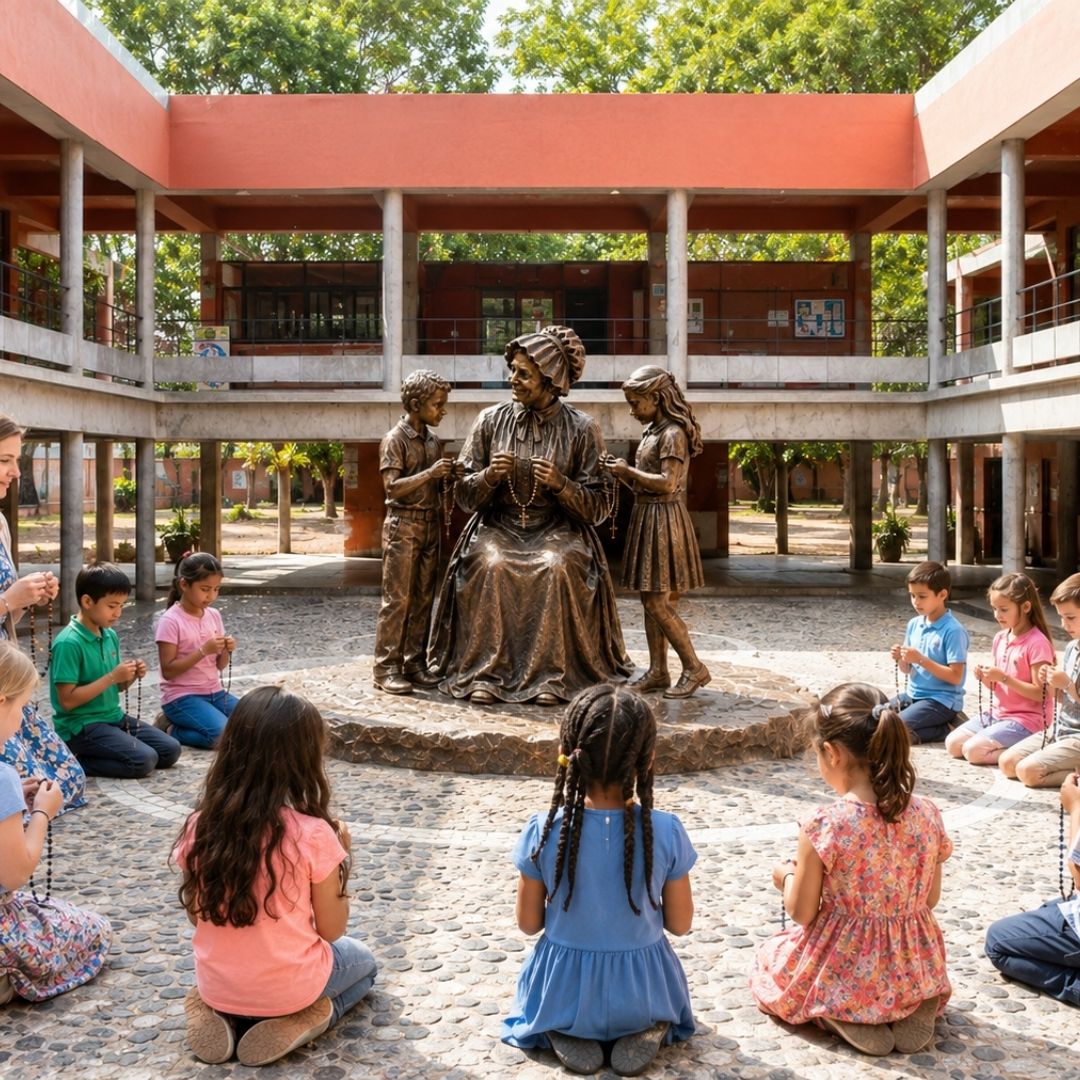
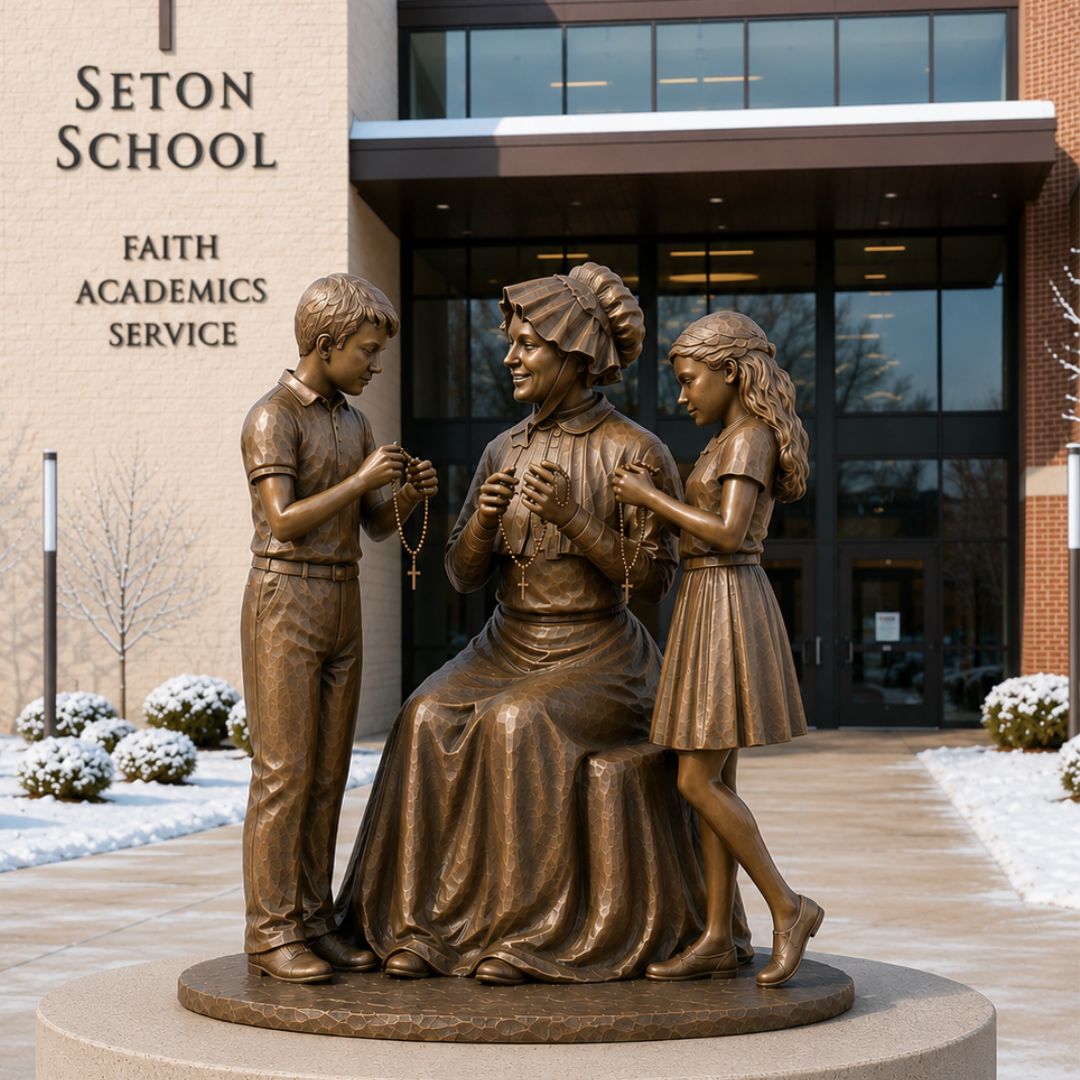
That was the thinking behind Indweller’s Teaching the Faith, a sculptural depiction of St. Elizabeth Ann Seton with children. Rather than presenting Seton alone as a distant historical figure, the composition shows her actively teaching children the Rosary.
That action becomes the symbolism. The children are being taught, but what they are learning is not confined to an academic subject. They are being formed in prayer and introduced to a faith that can accompany them throughout their lives. In one scene, the sculpture expresses something fundamental about the purpose of Catholic education: the formation of the whole child—intellectually, morally, and spiritually.
This illustrates an important principle when choosing or representing a patron saint. Sometimes the most meaningful symbol is not an object placed in the saint’s hand. It is an action: a teacher teaching, a missionary walking with people, a caregiver comforting someone who is suffering, or a saint serving a person experiencing poverty.
When the action of the saint reflects the mission of the institution, sacred art can communicate that mission before anyone reads a plaque or explanation.
Look Beyond the Most Familiar Catholic Saints
Catholic communities understandably gravitate toward saints they already know: Francis of Assisi, Thérèse of Lisieux, Joseph, Anthony, Patrick, and other beloved figures. There is nothing wrong with choosing a familiar saint when that saint genuinely reflects the mission of the institution. Familiarity, however, should not be the primary qualification.
The communion of saints encompasses people from an extraordinary range of cultures, centuries, occupations, personalities, and life experiences. There are scholars and laborers, missionaries and mothers, teenagers and grandparents, martyrs and mystics, immigrants and converts. There are saints from Africa, Asia, Europe, North America, South America, and the Middle East.
Exploring this broader communion can reveal a saint whose life speaks much more specifically to a particular community. Instead of asking only, Which saints will everyone recognize?, committees might ask, Which saint has a story we would want our community to discover?
A patron does not need to be immediately recognizable to be meaningful. In fact, discovering an unfamiliar saint together can become part of the spiritual formation of an institution.
Consider Who Actually Makes Up the Community
The demographics and lived experience of a Catholic community should also be part of the discernment. Who attends the school? Who worships in the parish? Which cultures and histories are represented among the people the institution serves? And perhaps just as importantly, whose stories have traditionally been missing from the Catholic names and images those people encounter?
For generations, Catholic institutions in North America frequently drew their names from a relatively familiar group of predominantly European saints. Those saints remain an important part of the Church’s spiritual inheritance, but the communion of saints is far larger and more diverse. Increasingly, Catholic communities are discovering patrons whose lives reflect the truly global character of the Church.
St. Josephine Bakhita is a striking contemporary example. Born in Sudan, kidnapped as a child and sold into slavery, Bakhita eventually gained her freedom in Italy and became a Canossian religious sister. Her extraordinary journey from enslavement to freedom, and particularly her refusal to allow suffering to extinguish her capacity for faith, hope, and forgiveness, gives Catholic institutions an unusually rich story around which to build a community identity.
Her growing presence as a namesake for Catholic schools is significant. New St. Josephine Bakhita Catholic schools have opened in recent years in communities as geographically distant as Ontario, Alberta, and Australia. When a new Catholic school chooses Bakhita rather than automatically returning to one of the traditional school names, it makes a statement about what kind of story it wants its students to inherit: one involving human dignity, resilience, freedom, forgiveness, and hope.
Sacred art can make those ideas tangible. In Indweller Artistic’s Freedom in Christ, St. Josephine Bakhita is depicted with broken chains and her arms raised, holding a cross and a lily. The symbols allow a child who knows nothing about Bakhita to begin asking questions. Why are there broken chains? Why is she joyful? What happened to her? What does freedom mean in her story? The sculpture becomes an introduction to the patron rather than simply an identification of her.
Representation matters here as well. For children of African descent, encountering an African woman among the saints honored prominently on a Catholic campus can carry particular significance. But Bakhita’s relevance should never be confined to African or culturally diverse communities. Her story addresses universal Catholic themes: the inherent dignity of every human person, freedom, suffering, forgiveness, hope, and the transformative power of faith.
An African American Madonna and Child can make a related but somewhat different contribution. It can help a Catholic community see the universality of Mary and Christ reflected in its sacred imagery. Bakhita, however, demonstrates something specifically important about choosing a patron saint: sometimes looking beyond the most familiar names allows an institution to discover a story that speaks more powerfully to its mission and to the world its students are actually entering.
Think About the Particular People the Patron Will Serve

Different communities also need different kinds of witnesses. Age and stage of life can be especially important for Catholic schools, university campus ministries, and parish young adult centers.
For young adult ministries, St. Pier Giorgio Frassati offers a particularly natural connection. His life combined friendship, outdoor adventure, a deep prayer life, and remarkable service to people living in poverty. His popularity among Catholic young adult communities is understandable: Frassati presents holiness as something energetic, joyful, social, and deeply engaged with the world.
For younger people growing up in a digital culture, St. Carlo Acutis offers another kind of connection. His interest in computers and technology existed alongside a profound devotion to the Eucharist. In Indweller’s Highway to Heaven, imagery incorporated into Carlo’s laptop connects a monstrance, a highway, and a setting sun, visually linking his modern life with his Eucharistic spirituality.

The point is not that every young adult ministry should choose Frassati or every Catholic school should choose Carlo. In fact, that would defeat the purpose of genuine discernment. Their usefulness as examples lies in something broader: the life of a patron should speak naturally to the lives of the people who will encounter that patron.
Don’t Overlook Local and Institutional History
Sometimes the most meaningful patron is discovered not by looking outward, but backward. Research the history of the parish, school, university, or neighborhood. Who founded it? Which religious community shaped it? Which immigrant populations built the original parish? What challenges did the institution face? What ministries became particularly important?
Even an institution that has carried a saint’s name for 50 or 100 years may discover that many members of the present community know surprisingly little about that saint. That creates an opportunity for rediscovery. The question changes from Why did they choose this saint? to What does this saint have to say to us now?
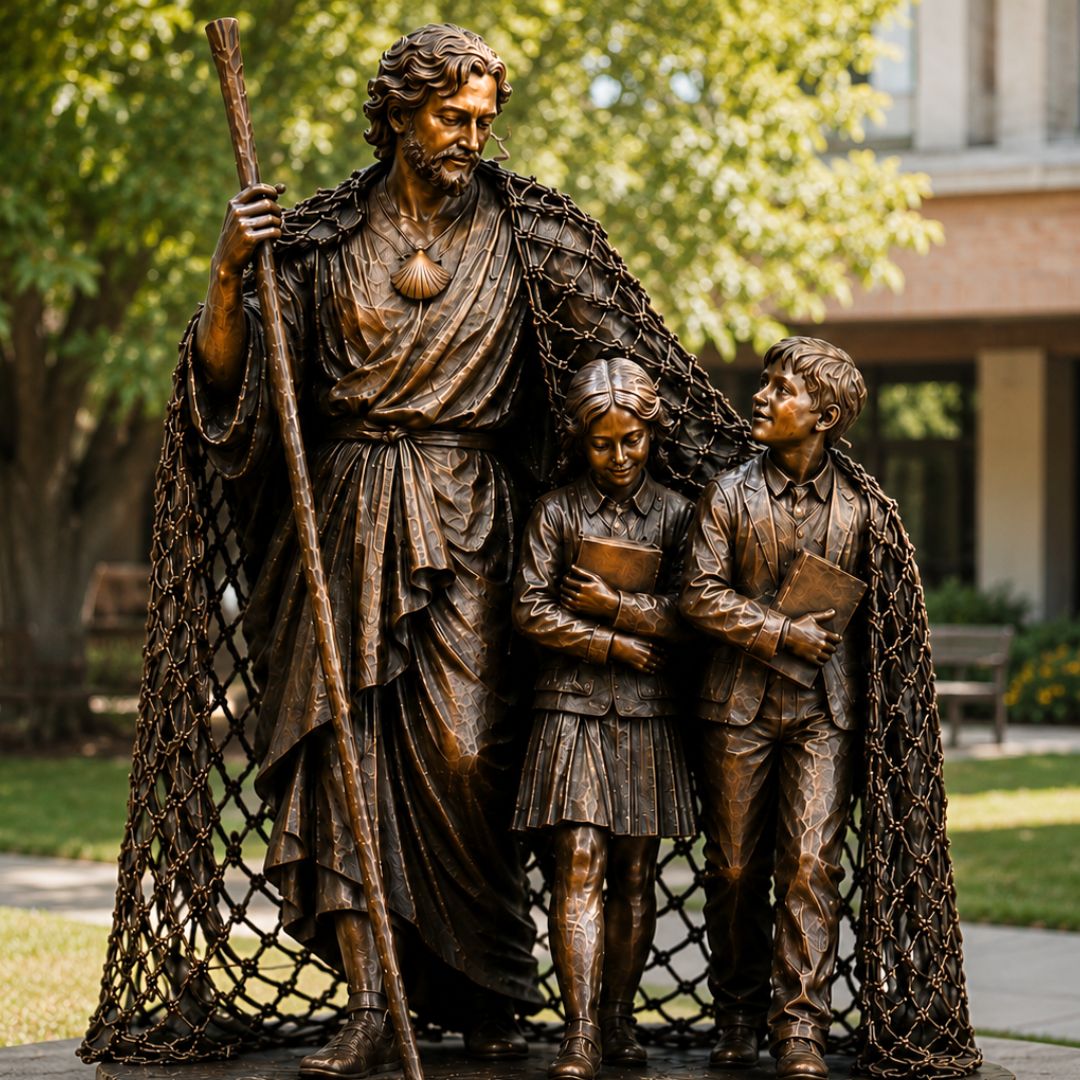
A Catholic school named for St. James the Greater, for example, can move beyond simply displaying the apostle’s name. Students can encounter James as apostle, pilgrim, missionary, and intercessor. Sacred art can reinforce the idea that the school’s patron is not merely a historical namesake but someone whose intercession the community actively seeks.
That creates a fundamentally different relationship between a Catholic institution and its patron. The saint’s name is no longer simply institutional branding inherited from a previous generation. It becomes part of the spiritual life of the community.
Ask What the Saint Can Teach the Community
One of the strongest tests for a potential patron is surprisingly simple: What could this saint teach us?
A patron should provide more than identification. The saint’s life should offer something worth returning to year after year. For a school, that might mean courage, perseverance, intellectual curiosity, friendship, service, or fidelity. For a university, it might involve the relationship between faith and reason, leadership, scholarship, or the pursuit of truth. For a healthcare ministry, compassion and human dignity might be central. For a parish, the saint might illuminate evangelization, hospitality, prayer, family life, Eucharistic devotion, or care for the poor.
This question also prevents the patron saint from becoming the Catholic equivalent of a mascot. Catholic patronage is fundamentally relational. The saint is someone whose example can be studied, whose virtues can be imitated, and whose intercession can be sought.
Let Symbolism Connect the Saint to the Particular Place
Once a saint has been selected—or an existing patron is being rediscovered—another important question emerges: How should this saint be represented here?
Catholic sacred art has always relied on symbolism. Keys identify Peter. Lilies frequently accompany Joseph. Roses evoke Thérèse. Books can signify teaching, scholarship, or a saint’s writings. But commissioned sacred art allows an institution to go further. The symbolism can connect the saint not only to his or her historical life, but also to the specific mission and physical location where the artwork will stand.
The examples above illustrate how different that symbolism can be. Clare’s book connects her history with the intellectual life and Franciscan identity of a university. Seton teaching children the Rosary embodies the mission of Catholic education. Bakhita’s broken chains transform a painful part of her history into a powerful expression of freedom. Symbols associated with Carlo allow contemporary students to begin understanding why his life matters to them.
Sometimes an institution can even develop symbolism unique to its relationship with its patron. The question need not be simply, How has this saint traditionally been depicted? It can also be, What aspect of this saint’s life does our community most need to encounter?
Placement matters as well. A saint positioned near a school entrance can welcome arriving students. A sculpture surrounded by benches can create a place for conversation and prayer. A figure located along a heavily travelled campus walkway becomes part of everyday life rather than something encountered only during formal religious occasions. Sacred art works differently when students pass it twice a day, when families gather around it after Mass, or when graduates pose beside it years after leaving campus.
The site itself can become part of the symbolism.
Involve the Community in Choosing or Rediscovering a Patron Saint
Choosing a Catholic patron can become a valuable community-building exercise. Rather than having a small committee simply announce a decision, institutions can invite meaningful participation. Students might research candidate saints. Parishioners could submit suggestions and explain their reasoning. Faculty could examine connections between potential patrons and the school’s mission. Local historians could investigate the institution’s origins. Clergy and religious communities could provide theological and spiritual guidance.
The process should not become a popularity contest. Instead, participation can turn the discernment itself into an opportunity for Catholic formation, history, and storytelling.
The same approach works when the patron has already been chosen. A school celebrating its 75th anniversary, for example, might use the occasion to investigate its patron, commission new sacred art, develop prayers or traditions around the saint, and introduce a new generation of students to the person whose name they encounter every day.
Choose a Story, Not Just a Name
Ultimately, choosing a patron saint is an act of storytelling. Every Catholic institution tells a story about what it believes matters. Its architecture tells part of that story. Its liturgy tells part of it. Its traditions, curriculum, ministries, and sacred art tell other parts. A patron saint can bring those pieces together.
The strongest patron is not necessarily the most famous saint or the saint whose statue appears most frequently in religious catalogs. It is the saint whose life allows a community to say, “This story has something to do with ours.”
For one university, that may be Clare’s courage, intellect, and leadership. For a Catholic school, Elizabeth Ann Seton may embody the inseparable relationship between education and formation in faith. For another school, Bakhita’s journey from enslavement to freedom may provide a profound witness to human dignity, resilience, forgiveness, and hope. For a community named for St. James, rediscovering him as apostle and intercessor can renew an identity that has existed for generations. For a young adult ministry, Pier Giorgio Frassati may demonstrate that an active, joyful life and a serious commitment to faith belong together.
And sometimes the right answer is the saint whose name has already been carved above the entrance for generations—but whose remarkable story is simply waiting to be rediscovered.
A patron should ultimately become part of the life of the community. Celebrate the saint’s feast day. Teach the saint’s story. Incorporate the patron into school or parish prayer. Explore the saint’s writings. Create traditions connected to the saint’s life and virtues. If sacred art is commissioned, think carefully about what that artwork should communicate to someone encountering the saint for the first time.
A successful representation should make a child, student, parishioner, or visitor curious: Who is this person? Why are they holding that? What does that symbol mean? Why did this community choose this particular saint?
Those questions turn a name into a story, a sculpture into a teaching opportunity, and an institutional identity into an invitation to faith.
Perhaps that is the best criterion of all when choosing a patron saint: Choose someone whose story your community will still want to tell generations from now.
Considering Sacred Art for Your Patron Saint?
Whether your community is choosing a patron for the first time or rediscovering a namesake it has carried for generations, sacred art can turn that story into something students, parishioners, and visitors encounter every day. Indweller Artistic works with Catholic schools, universities, parishes, and ministries to design sculpture whose symbolism reflects both the saint’s life and the mission of the place it will stand.