
Long before a visitor reads a mission statement or meets a pastor, teacher, or administrator, the entrance to a Catholic institution has already begun communicating what the community believes, whom it serves, and what it holds sacred.
A family arriving at a Catholic school for the first time may know very little about it beyond what they have read online. A visitor approaching a parish church may never have attended Mass there. Someone entering a Catholic cemetery may arrive carrying grief. A prospective student walking across a university campus may still be trying to understand what makes the institution distinctly Catholic.
Yet before any of them speaks with another person, something has already begun to happen.
They have seen the building. They have followed the walkway. They have passed the landscaping and signage. They have approached the doors. And, consciously or not, they have begun forming an impression of the place they are about to enter.
That makes the entrance to a Catholic institution far more than an architectural necessity. It is a threshold—and an opportunity to say something important about who lives, worships, learns, serves, or rests within.
Thoughtfully conceived Catholic sacred art can make that message visible.
The Entrance as a Sacred Threshold
Catholic architecture has always understood that movement through physical space can carry spiritual meaning. We enter a church through a narthex. We move toward an altar. We kneel before the tabernacle. Processions, doors, aisles, shrines, and sanctuaries all help distinguish ordinary movement from sacred encounter.
The entrance participates in that language.
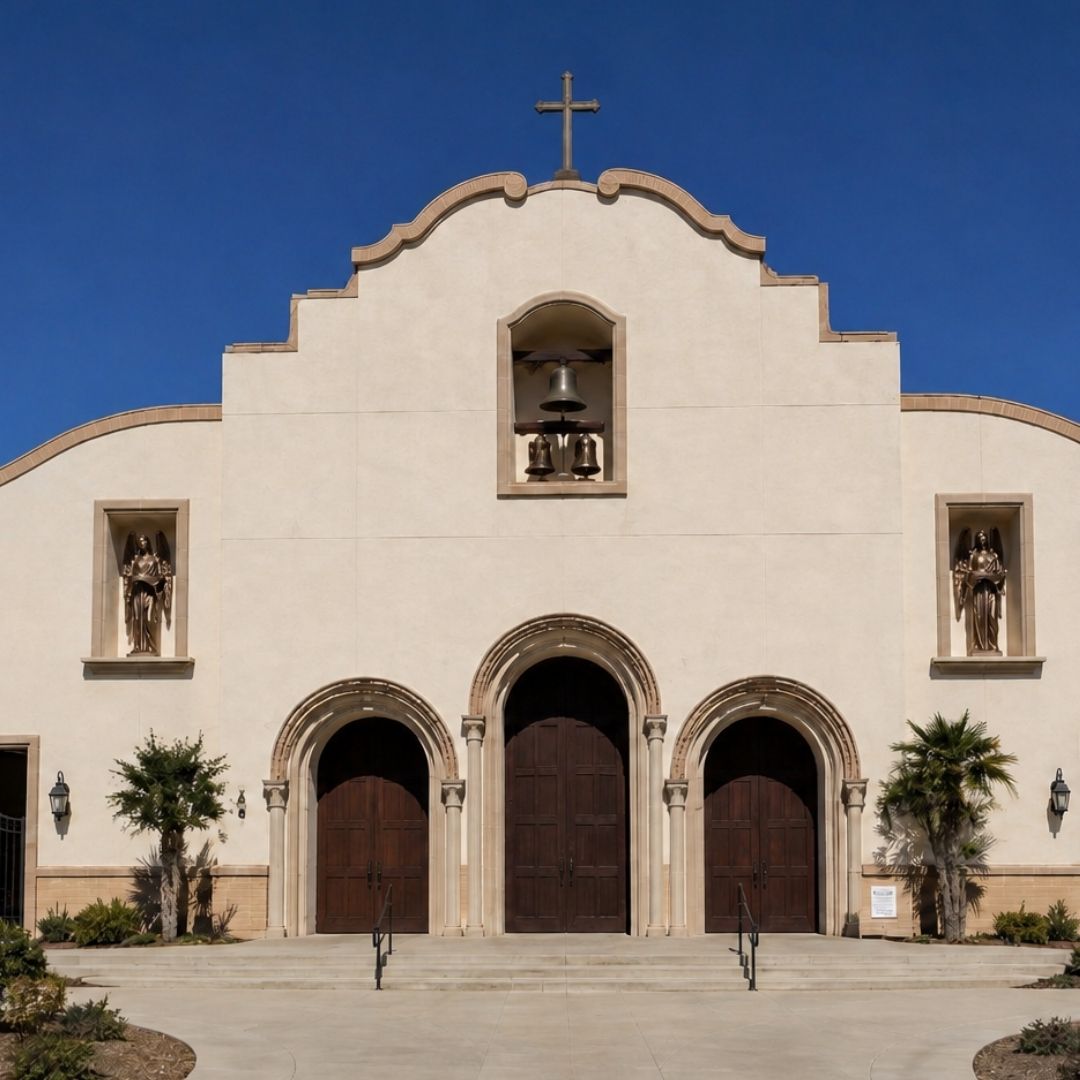
This is particularly apparent at St. Charles Borromeo, where monumental Entrance Angels stand prominently above the approach to the church. Their scale matters, as does their elevated relationship to the architecture. They are not garden ornaments positioned somewhere near the building. They belong to the experience of entering it.
Even more significantly, the angels carry scrolls.
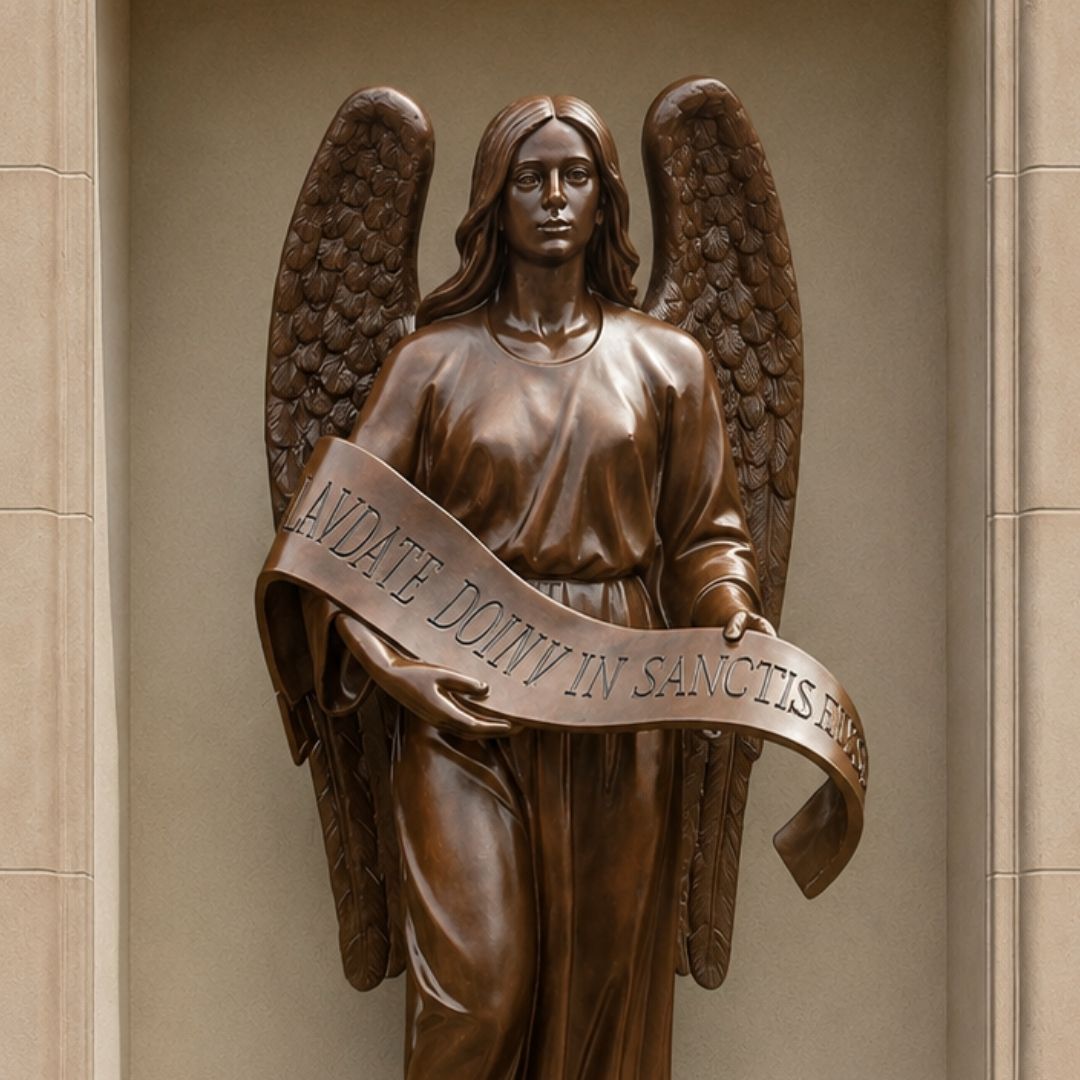
One bears the words Laudate pueri Dominum—“Praise the Lord, you servants of the Lord.” The other proclaims Laudate Dominum in sanctis eius—“Praise the Lord in His sanctuary.”
The texts transform the figures from decoration into proclamation. The angels do not merely mark the entrance as religious; they tell the approaching visitor something about what lies beyond the doors and how one should enter it. This is a place of praise. This is a sanctuary.
It is an ancient idea expressed through sacred art and architecture: crossing the doorway of a church is not quite the same as walking into another public building. One is entering a place deliberately set apart for worship.
What Do You Want People to Understand Before They Enter?
That question should precede the selection of any church entrance statue or Catholic school sculpture.
It is tempting for a committee beginning a church beautification project to start with objects: Should we put a statue here? Which saint should it be? How large should it be?
A more productive starting point is conceptual: What do we want someone to understand about this community when they arrive?
For some institutions, the answer begins quite simply with Christ.
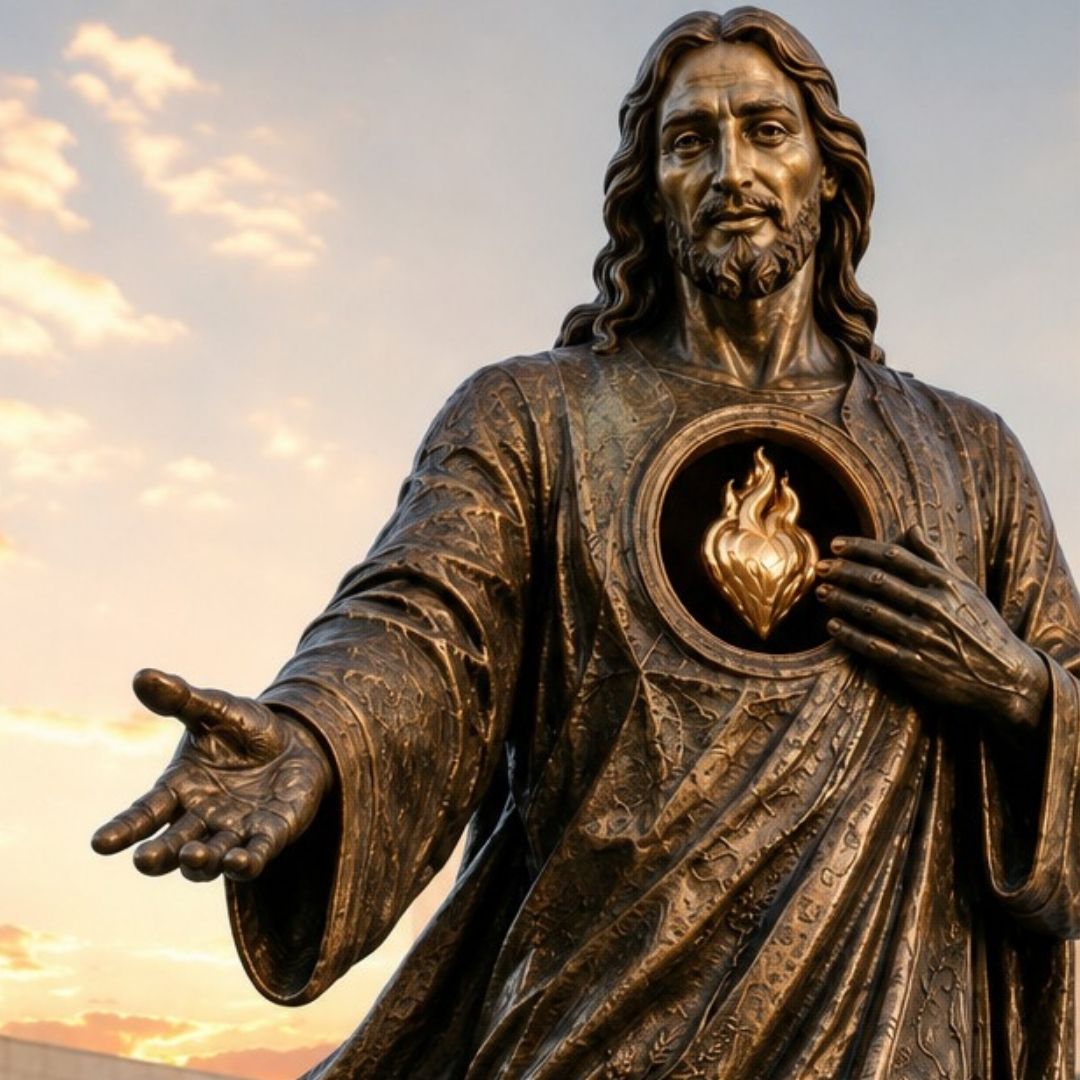
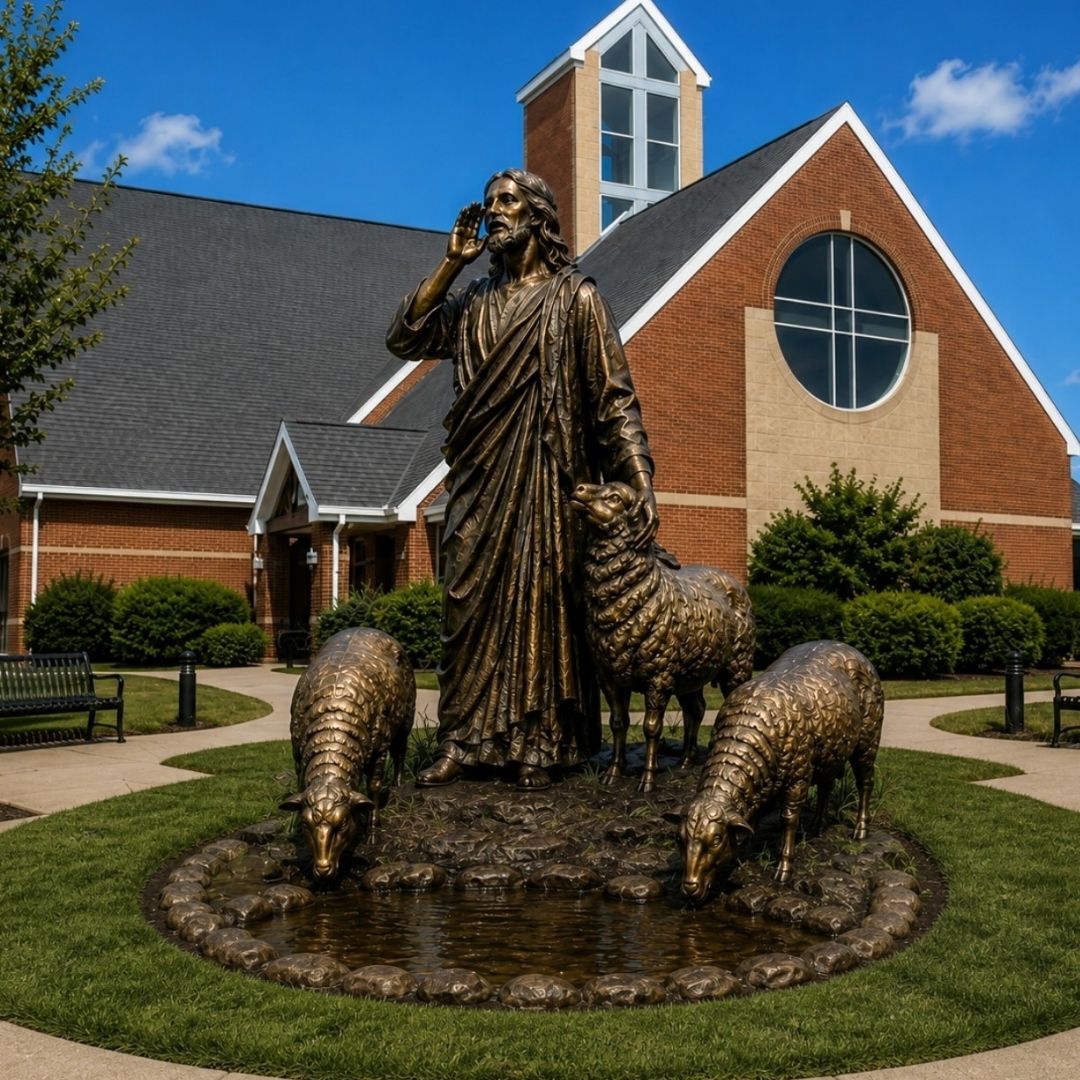
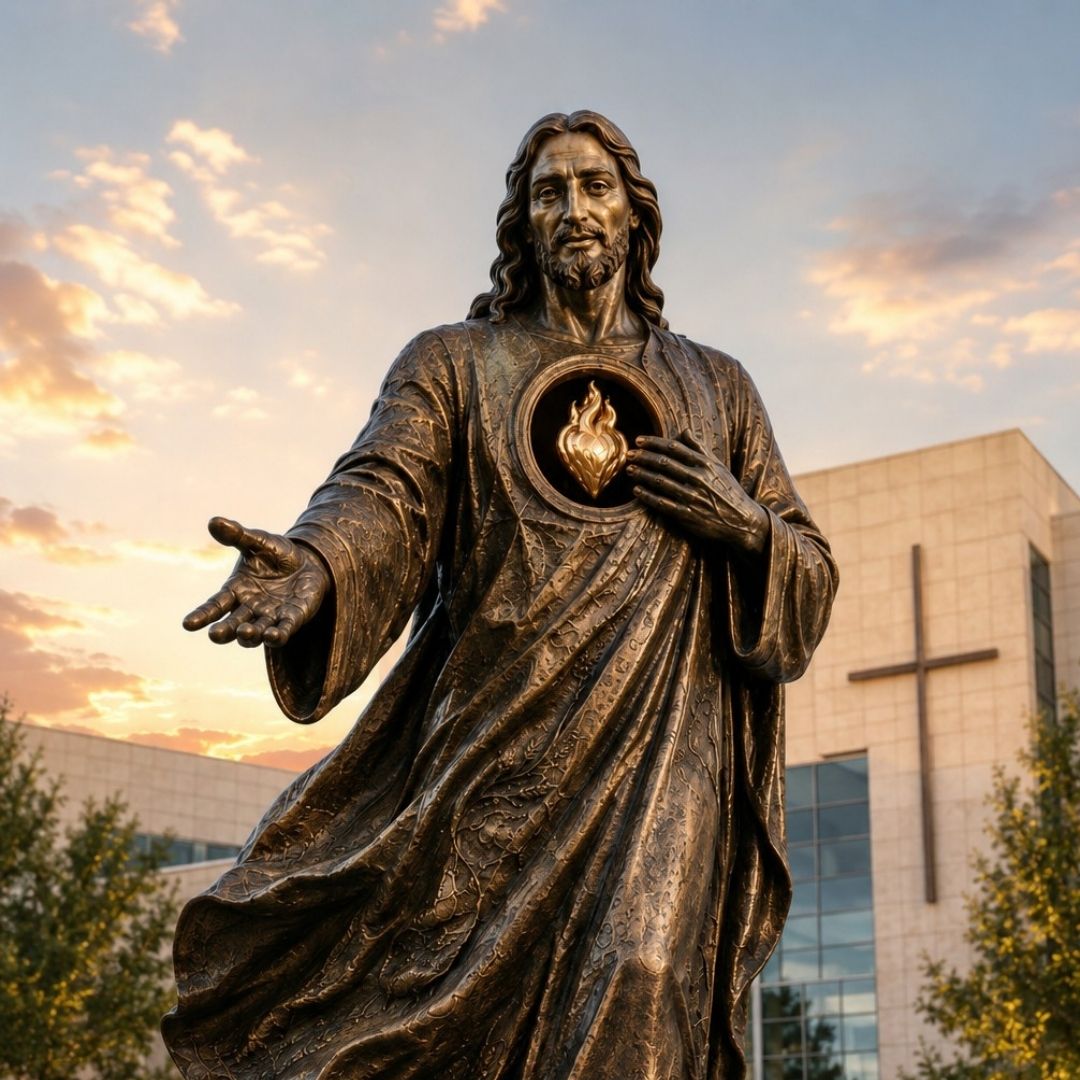
The Sacred Heart of Jesus sculpture His Heart Burns for All demonstrates how directly sacred sculpture can communicate that priority. The visible Sacred Heart identifies Christ immediately, but the figure does more than present a familiar devotion. Christ extends one hand toward the approaching person. His posture is open; His expression invites rather than distances.
At an entrance, those artistic decisions acquire particular significance. The sculpture can communicate welcome, mercy, belonging, and invitation while answering perhaps the most fundamental question a Catholic institution can answer visually: Who is at the center of this place?
That message is different from placing a Catholic logo on a sign. Catholic identity is not branding applied to architecture. Sacred art can express theology and devotion in ways institutional graphics cannot. An outstretched hand can make the welcome of Christ physically present in the visitor’s approach.
The answer will be different at another institution.
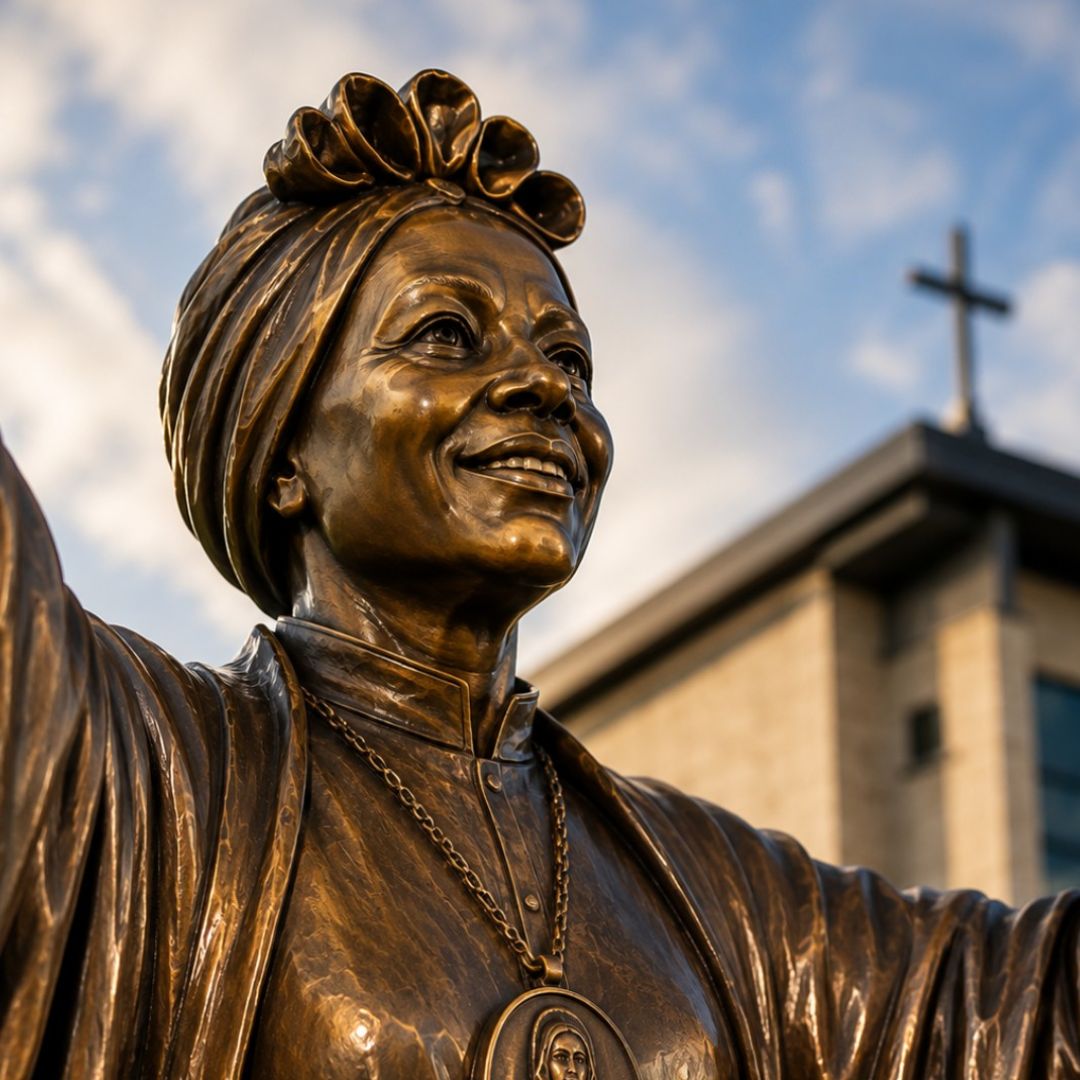
Brother André Bessette, known as “God’s Doorkeeper,” offers an especially meaningful example of sacred art placed at an entrance. The sculpture recalls André’s humble service as doorkeeper at Notre Dame College in Montreal, where countless people came to him seeking prayer, consolation, and, often, healing. In the composition, a man approaches on crutches—a reminder of the suffering people André welcomed and of his unwavering practice of directing their hope toward St. Joseph and ultimately toward Christ.
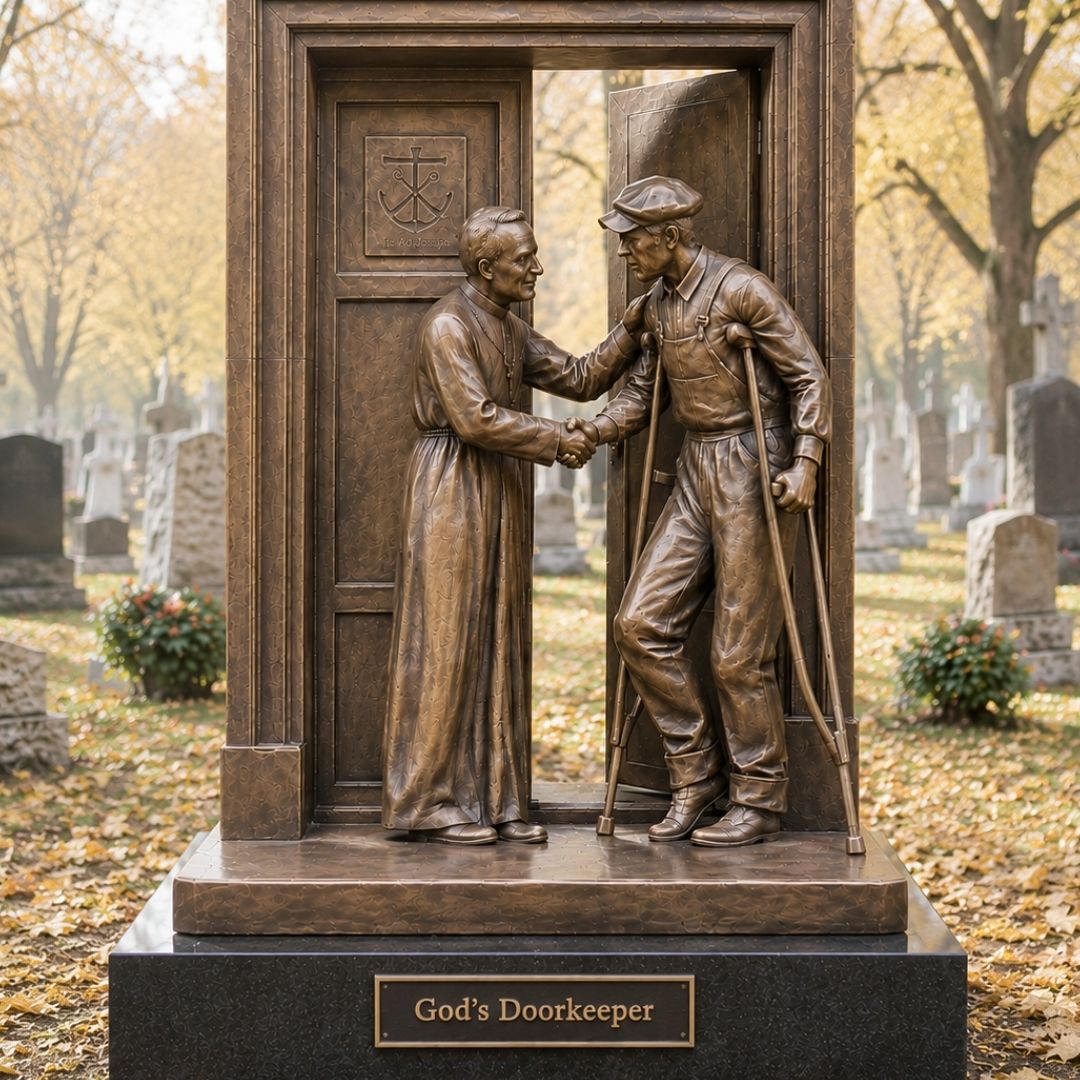
At the entrance to a Catholic cemetery, those elements acquire another layer of meaning. André once received people at the door; now his image stands at a threshold welcoming those who arrive carrying grief. The open doorway behind him can also suggest passage—not death as a final barrier, but the Christian hope of a life that continues beyond it. Without needing to state that theology in words, the sculpture can speak simultaneously of hospitality, healing, accompaniment, and hope in eternal life.
Here, the relationship between sacred art and its setting is not incidental. The location helps complete the story.
When the Entrance Teaches
The same principle has particular power on a Catholic school campus.
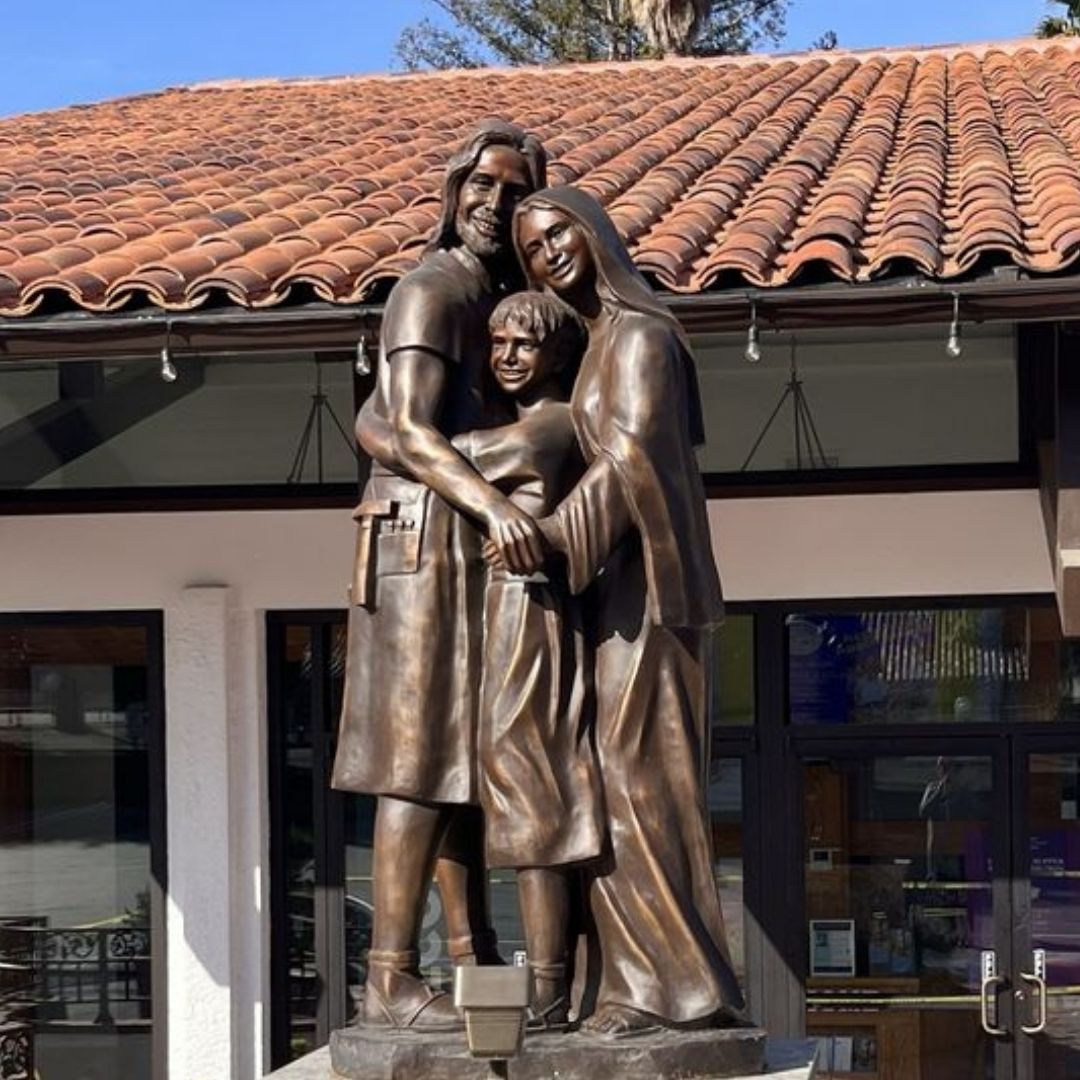
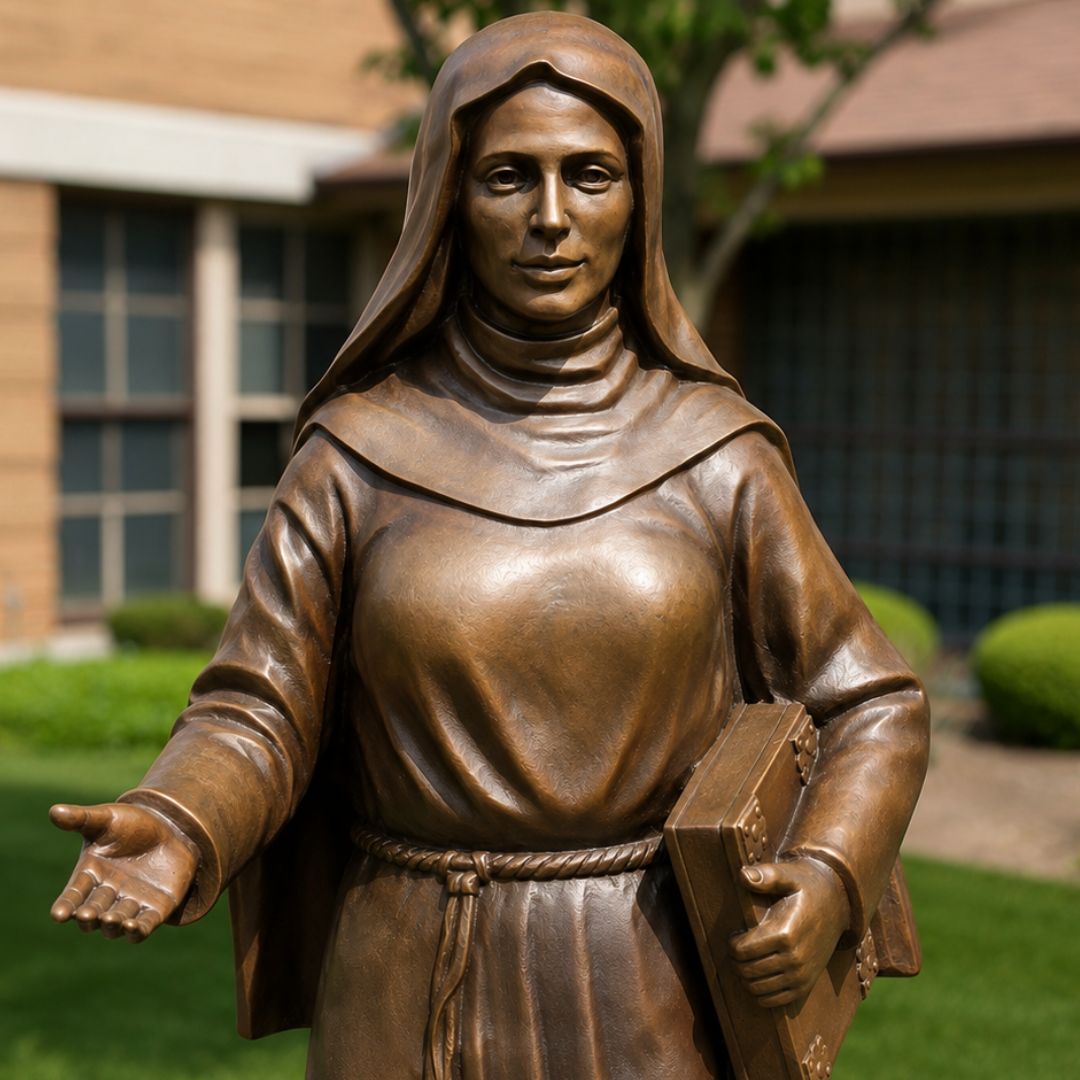
St. Elizabeth Ann Seton’s importance to Catholic education in the United States makes her a natural figure through whom a school can communicate its purpose. A sculpture such as Teaching the Faith at a Catholic school entrance does more than identify a saint. It connects the daily activity taking place beyond those doors with a much larger Catholic tradition of education and formation.
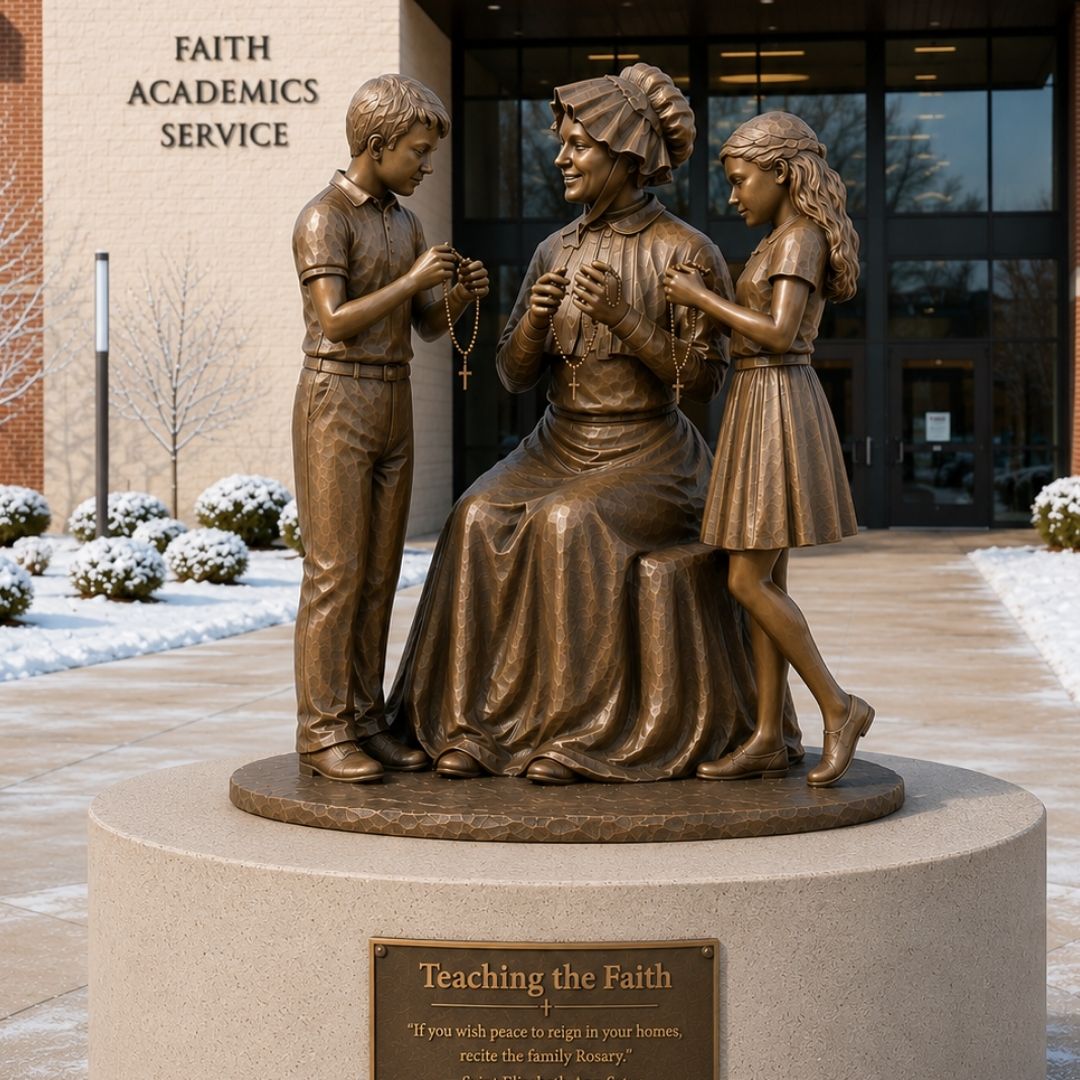
A child walking past Seton each morning is being reminded—even before entering the classroom—that education here is intended to form more than academic competence. Parents encounter the same message. Teaching, faith, and formation belong together.
A patron saint statue can go further still by helping explain what Catholic patronage actually means.
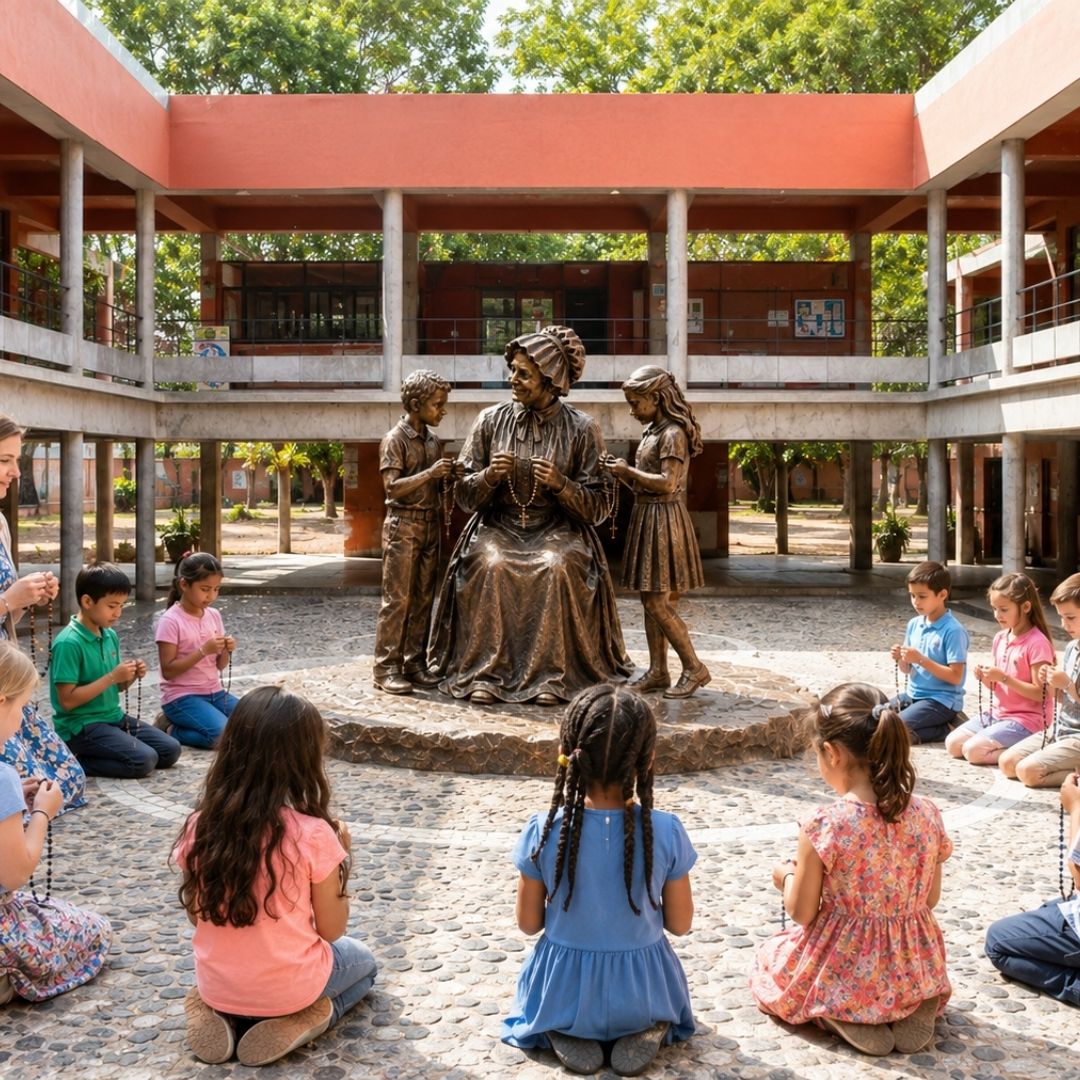
In the St. James the Apostle sculpture, children are gathered within and around the symbolism of the apostle’s net. The net recalls James the fisherman, but in this composition it can also be understood as a visual expression of patronage, protection, belonging, and intercession. The children are not merely standing beside the historical figure for whom their school was named; they are gathered within the symbolic reach of their patron.
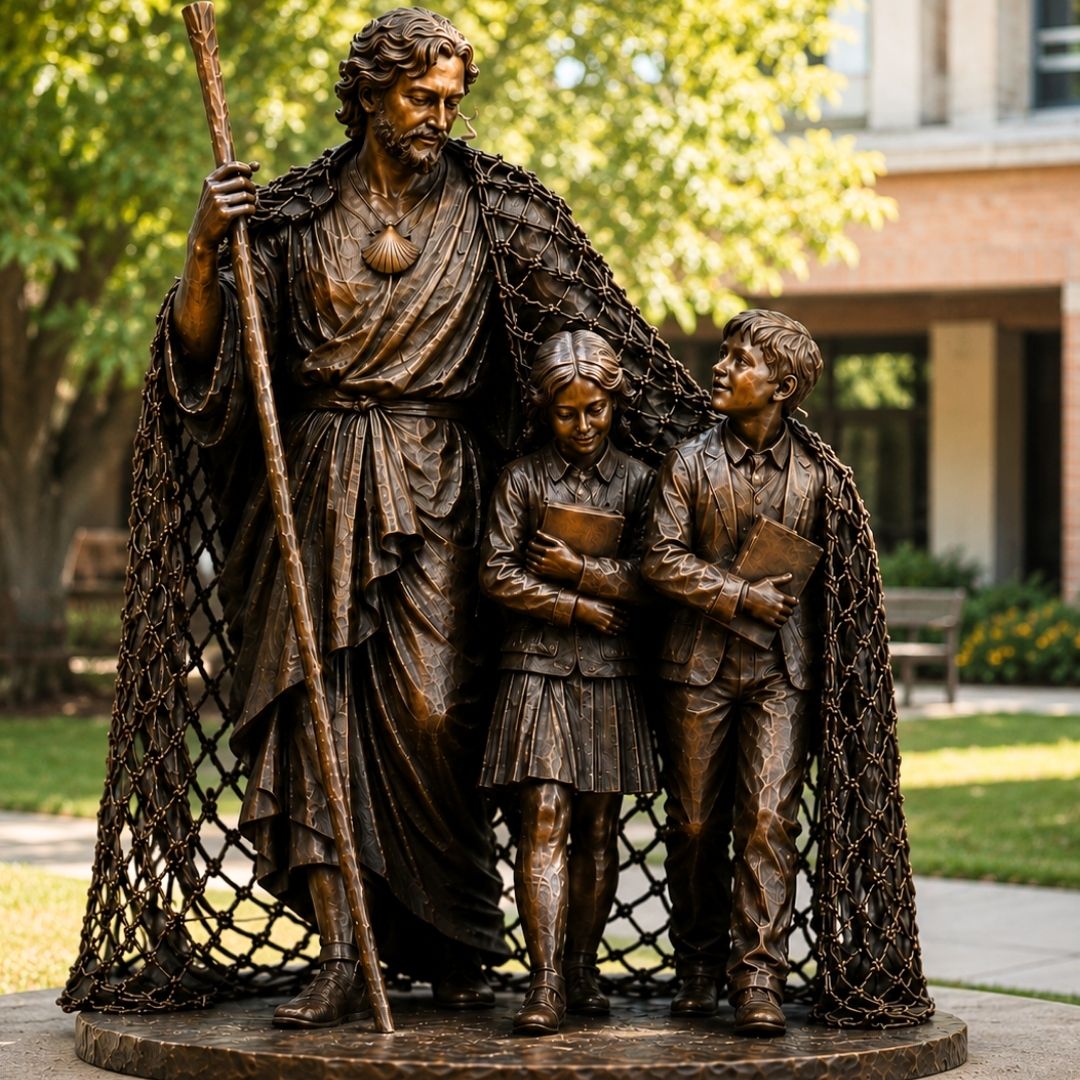
That matters because a patron saint can easily become little more than a name on a building or, at worst, the Catholic equivalent of a mascot. Catholic theology says something much richer. The communion of saints means that the relationship between a community and its patron is not merely commemorative. The saint remains a member of the Body of Christ who intercedes for the faithful.
A well-conceived Catholic school sculpture can teach that theology without turning the entrance into a theology lesson. Children can grow up seeing themselves represented within the visual story of their patron.
Different Missions Require Different Entrances
There is no single formula for sacred art for churches or Catholic institutions because institutions do not all have the same mission.
A parish entrance might emphasize Christ, the Eucharist, hospitality, prayer, or the parish patron. A school might emphasize formation, wisdom, intercession, and the communion of saints. A Catholic university may want its campus design to express intellectual formation, service, institutional heritage, or the relationship between faith and reason.
At a cemetery, the emotional and theological needs are different again. Sacred art near the entrance may speak most powerfully of resurrection, accompaniment, mercy, and Christian hope. At a Catholic hospital, healing and compassion may take precedence. At a retreat center or religious community, prayer, silence, vocation, or welcome may provide the central theme.
The essential principle remains the same: the sculpture should say something specific.
Simply installing a generic religious figure near a doorway does not automatically create meaningful Catholic identity. The better question is not What statue should we buy? but What should people understand about us before they enter?
Once that question has been answered, the subject, gesture, symbolism, and setting of the sacred art can grow from it.
This is also where an original religious sculpture commission can offer possibilities that an existing statue may not. The purpose is not originality for its own sake. Rather, a custom religious sculpture allows a community to ask whether a particular gesture, symbol, relationship, or narrative could express its mission more clearly.
Brother André’s doorway, the children gathered within St. James’s net, Christ’s welcoming hand, and angels carrying words of praise all communicate specific ideas. Those details are doing theological work. They give visitors something to understand, not simply something to look at.
Placement Is Part of the Message
Even the strongest artistic concept can lose much of its effectiveness if placement is treated as an afterthought.
Committees planning outdoor church statues or Catholic campus sculpture should experience the proposed site as visitors actually experience it. Where does the sculpture first become visible? Is that from the road, the parking area, or only when someone reaches the front doors? What is behind it? Does landscaping frame it or eventually obscure it? How does sunlight affect it during the hours when most people arrive? What happens after dark?
There is also the question of the natural path of approach. A sculpture may occupy an attractive location on a site plan yet sit outside the route most parishioners, students, families, or visitors actually use. Ideally, sacred art at an entrance should be encountered rather than sought out. It should become part of the experience of arriving.
Scale is equally important. A life-size figure that feels substantial in a studio may become visually insignificant against a large masonry façade. Conversely, a monumental sculpture can overwhelm a more intimate entrance. Elevated architectural placements, such as the Entrance Angels at St. Charles Borromeo, require figures whose proportions and silhouettes remain legible from below and at a distance.
Lighting, pedestal height, pedestrian sight lines, landscaping, and the relationship between sculpture and doorway should therefore be considered as parts of a single composition. If visibility from the road is important, the viewing distance changes decisions about scale and silhouette. If the primary encounter occurs on foot, facial expression, gesture, and smaller symbolic details may become more important.
The most successful church campus sculpture often feels as though the architecture and sacred art were meant to be encountered together, even when the sculpture was commissioned years after the building was constructed.
More Than a Religious Marker
There is an important distinction between making an institution visibly Catholic and communicating what its Catholic identity actually means.
A cross, a saint, or another recognizable religious image can identify a building as Catholic. That has value. But sacred art has the capacity to go further.
It can tell a visitor that Christ welcomes those who approach. It can tell a grieving family that Christian death is understood in the light of eternal life. It can tell a child that a patron saint is not merely the name of the school but an intercessor within the communion of saints. It can remind worshippers approaching a church that they are crossing into a sanctuary devoted to the praise of God.
In that sense, religious sculptures for churches, schools, cemeteries, universities, hospitals, and other Catholic institutions are not simply additions to the landscape. At their best, they become part of how the institution understands and expresses itself.
And because an entrance is encountered repeatedly, that message is not reserved for first-time visitors. A student may pass the same saint every morning for years. A parishioner may walk beneath the same angels every Sunday. Sacred art becomes woven into the ordinary rhythm of belonging to the place.
Look at Your Entrance as Though You Have Never Seen It
Catholic institutions understandably spend considerable time crafting mission statements. Schools articulate educational philosophies. Parishes develop welcome materials. Universities explain their Catholic identity. Cemeteries describe their ministry to grieving families.
But the physical environment speaks before any of those words are read.
Before your next building or facilities committee meeting, walk outside. Go beyond the front doors and stand where a first-time visitor actually begins approaching your church, school, university, cemetery, retreat center, hospital, or campus.
For a moment, forget everything you already know about the institution.
Look at the entrance as a stranger would. What tells you that this place is Catholic? What tells you what this particular Catholic community values? Is Christ visibly at its center? Does its patron have a meaningful presence? Does the approach communicate welcome, reverence, hope, formation, prayer, healing, or service? Does anything invite you to understand what happens beyond the doors?
Then ask the more difficult question:
What does our entrance say about who we are?
Thoughtfully chosen sacred art cannot communicate everything about an institution. But before a visitor attends Mass, meets a teacher, walks into a classroom, visits the grave of someone they love, or reads a mission statement, it can begin the conversation.
And sometimes, before anyone walks through the door, that is exactly where Catholic identity should begin.
Indweller Artistic works with Catholic parishes, schools, universities, cemeteries, retreat centers, hospitals, and other institutions to create original sacred sculpture shaped around the mission, setting, architecture, and devotional life of each community. From early concept development through scale, material, symbolism, and placement, the goal is to create sacred art that belongs to the place it serves—and communicates something meaningful before a visitor ever walks through the door.