
How an original Good Shepherd sculpture uses gesture, landscape, water, and the words of Christ to turn a familiar biblical image into a place of encounter.
Few images in Christian art are as familiar as the Good Shepherd. For nearly two thousand years, Christians have depicted Christ carrying a sheep across His shoulders, gathering a flock around Him, or searching for the one that has wandered away. The image is comforting precisely because it is so familiar: Christ knows His people, protects them, seeks them when they are lost, and leads them home.
But familiarity can present an interesting challenge when creating original Catholic sacred art. How do you portray an image Catholics have seen countless times and invite them to experience it again with fresh eyes?
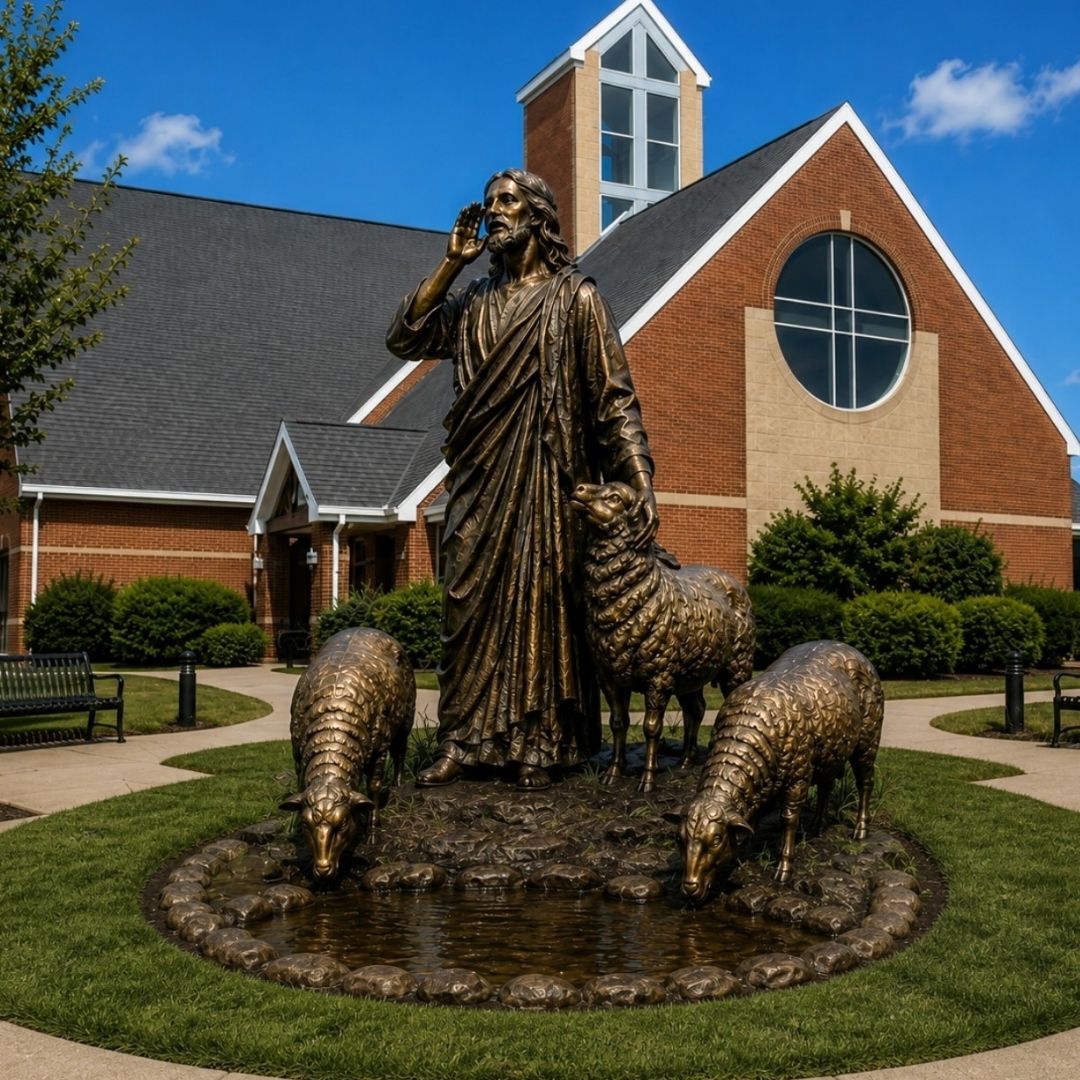
That question helped shape Indweller Artistic’s My Sheep Know My Voice. Rather than creating a conventional Good Shepherd statue intended primarily to be viewed from a distance, the composition was conceived as an encounter. Christ is not simply standing among sheep. He is calling. One sheep is already beside Him, receiving the reassuring touch of His hand, while others occupy the surrounding environment. Water, landscaping, pathways, and gathering areas extend the composition beyond the bronze itself.
The result illustrates an important principle in designing religious sculpture for churches: sacred art does not always have to end at the edge of the pedestal. Sometimes the surrounding space can become part of the story.
Beginning with the Voice of the Shepherd
The theological foundation for the sculpture comes from Christ’s words in the Gospel of John: “My sheep hear my voice; I know them, and they follow me” (John 10:27).
Those words change the way we understand the familiar Good Shepherd image. The relationship between shepherd and sheep is not merely one of protection. It is one of recognition. The shepherd calls, and the sheep know whose voice they are hearing.
That became important to the sculpture’s composition.
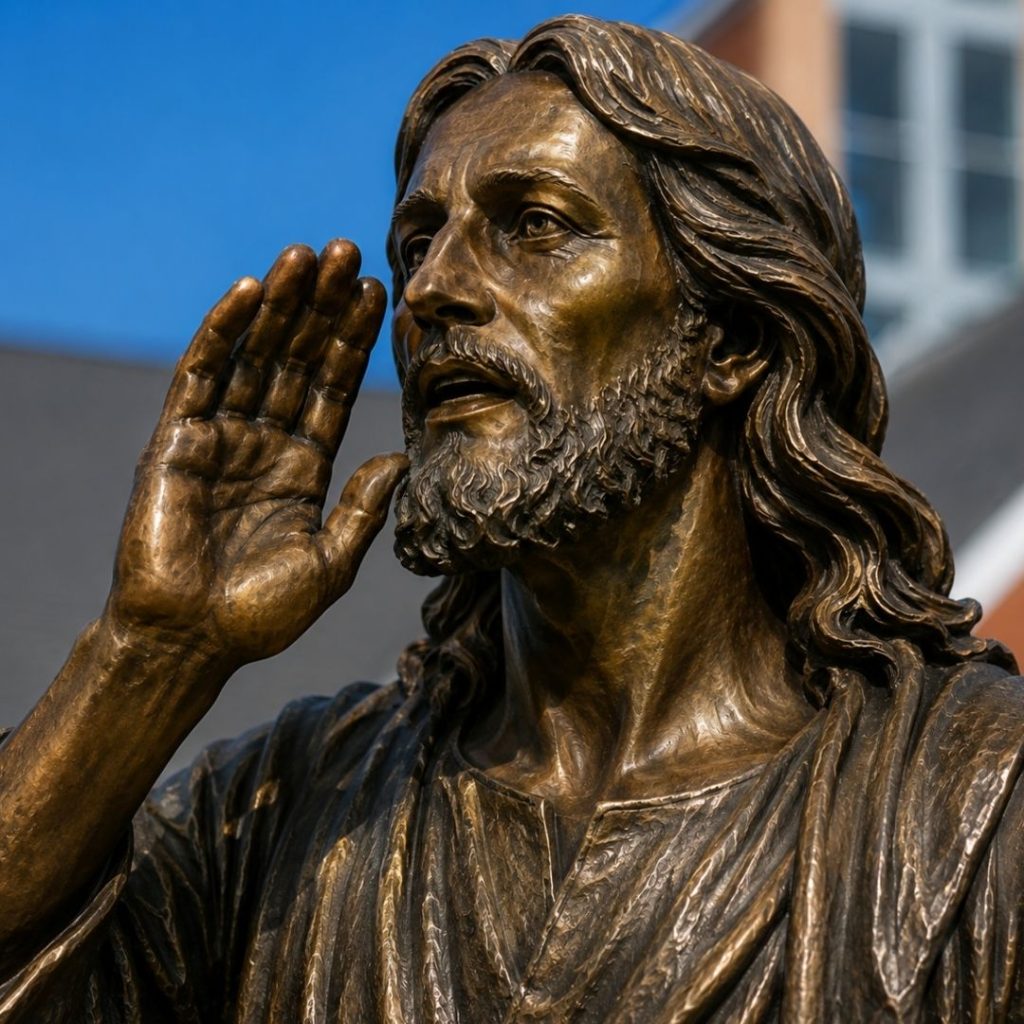
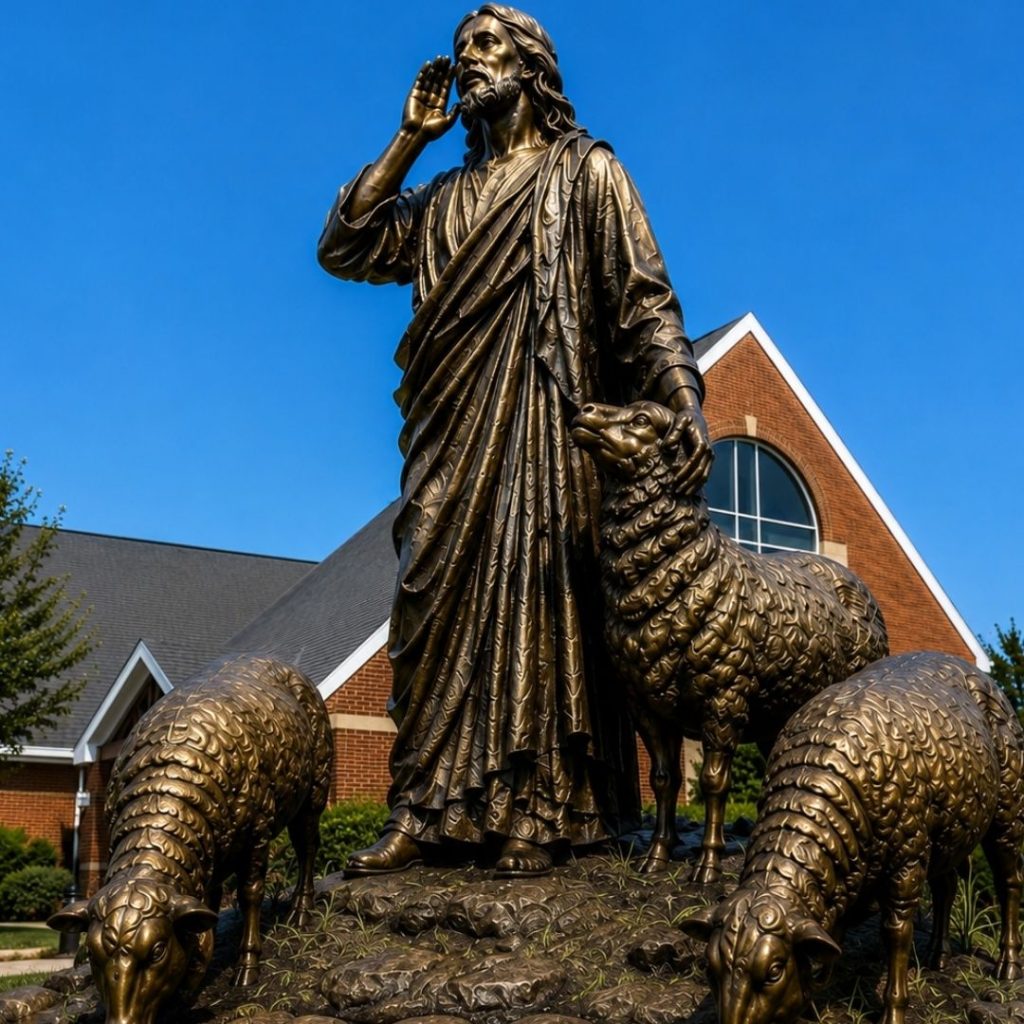
Christ’s raised hand is not simply a generic gesture of blessing. It suggests a Shepherd calling to His flock. His body language directs attention outward, beyond the immediate figures and into the space occupied by the viewer. At the same time, His other hand rests on a sheep already beside Him.
Together, those two gestures communicate different dimensions of the same relationship. One hand calls; the other reassures. Christ reaches toward those still approaching while remaining intimately connected to the one already at His side.
For a parish considering outdoor church statues, gestures like these matter. A sculpture can communicate theology through posture long before a visitor reads a plaque or understands every symbol incorporated into the work.
What Does It Mean to Be Known?
There is another phrase in John 10 that gives the Good Shepherd image much of its emotional power: “I know them.”
Being known is different from simply being counted among the flock.
The biblical shepherd knows the animals entrusted to him. He recognizes them individually and understands their needs. In Christian theology, that becomes an extraordinarily personal image of God’s relationship with humanity.
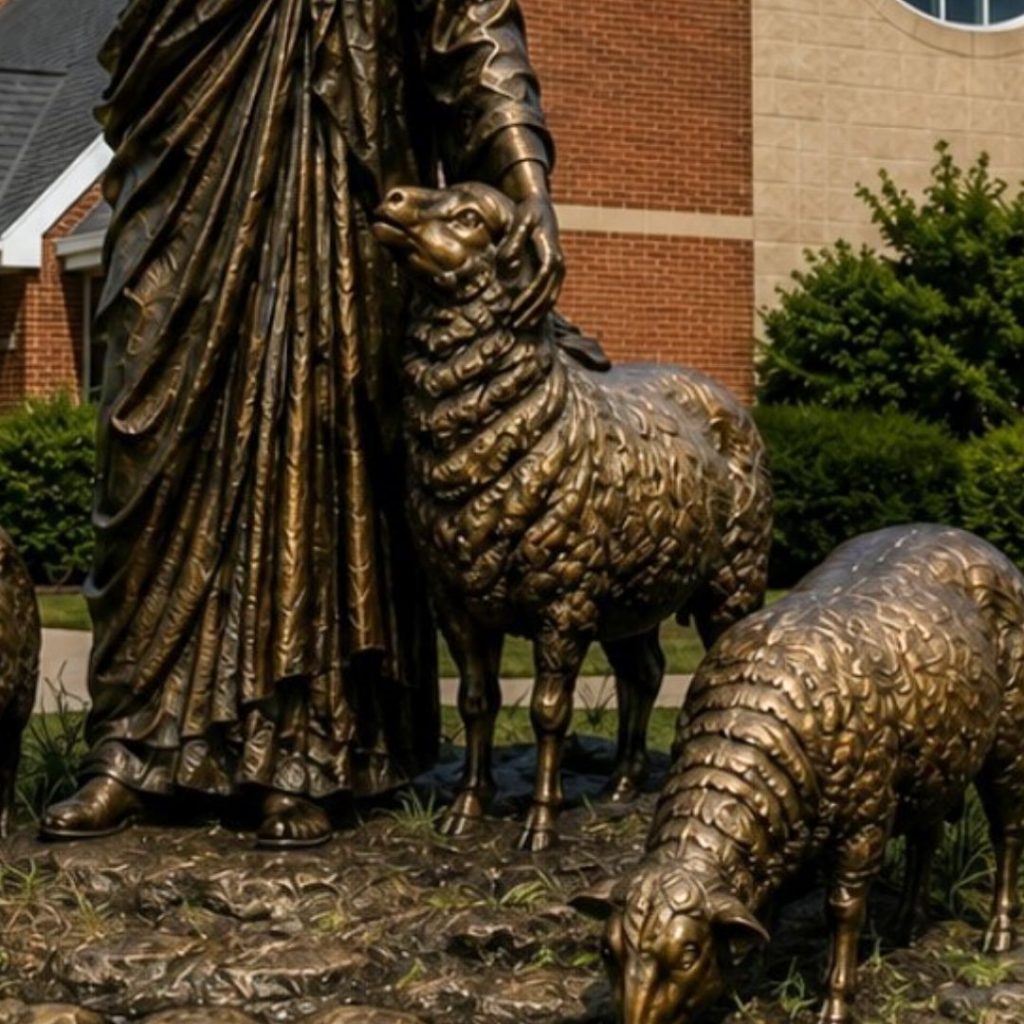
The sheep beneath Christ’s hand helps make that relationship visible. It is not lost somewhere within an anonymous flock. There is physical contact between shepherd and sheep.
That detail invites a more personal reading of the sculpture. The Good Shepherd does not merely care for humanity collectively. He knows the individual.
For someone encountering the sculpture during grief, uncertainty, loneliness, or prayer, that distinction can carry tremendous meaning. Sacred art becomes powerful when a theological truth ceases to feel abstract and becomes something a person can see and experience.
The Landscape Becomes Part of the Sculpture
One of the most important decisions in My Sheep Know My Voice was not made in bronze at all.
It was made in the landscape.
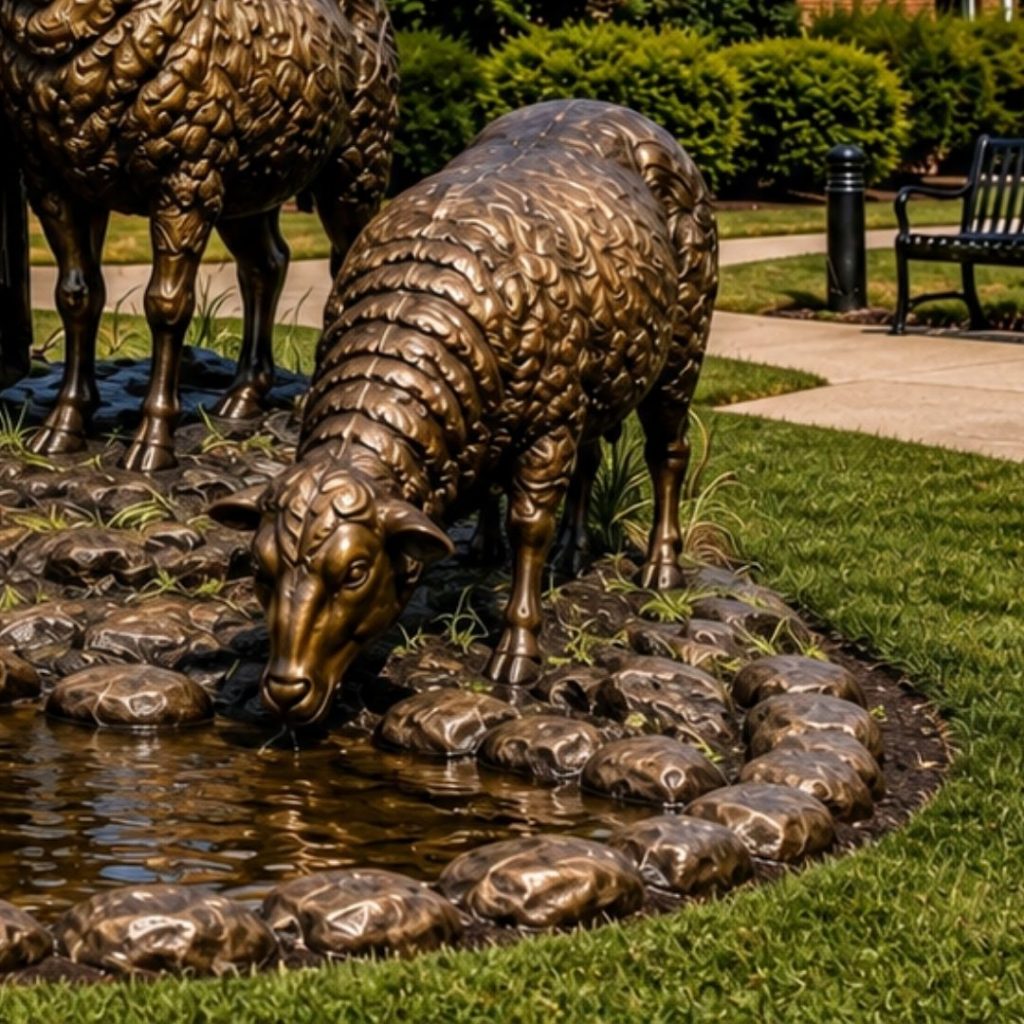
The Good Shepherd is inherently an outdoor image. Scripture gives us pastures, sheep, pathways, water, and a shepherd leading his flock. Placing such a sculpture within a carefully designed landscape allows those biblical references to extend beyond the figure itself.
In this installation, the sculpture is integrated with landscaped surroundings, pedestrian areas, benches, and a bronze pond. Two sheep near the water help expand the composition beyond Christ’s immediate presence.
The pond is particularly meaningful because water carries rich associations within the imagery of the shepherd. Psalm 23 immediately comes to mind: the Lord leads His flock beside still waters and restores the soul. John 10 emphasizes the Shepherd’s voice and relationship with His sheep. Within one environment, visitors can therefore encounter several interconnected scriptural ideas without turning the installation into a literal illustration of a single passage.
This is one of the advantages of thinking about Catholic church landscape design and sculpture together. Landscaping need not simply beautify the area around a statue. It can participate in the meaning of the sacred art.
From an Object to a Place
There is a significant difference between installing a sculpture and creating a sacred space.
A sculpture can be placed on a pedestal surrounded by lawn and still be beautiful. But when pathways, seating, landscaping, water, and sight lines are considered together, the installation can become something people actually enter.
That distinction was particularly appropriate for the Good Shepherd.
Christ’s invitation is relational. The Shepherd calls people toward Him. Designing an environment that allows visitors to physically approach the sculpture reinforces that idea.
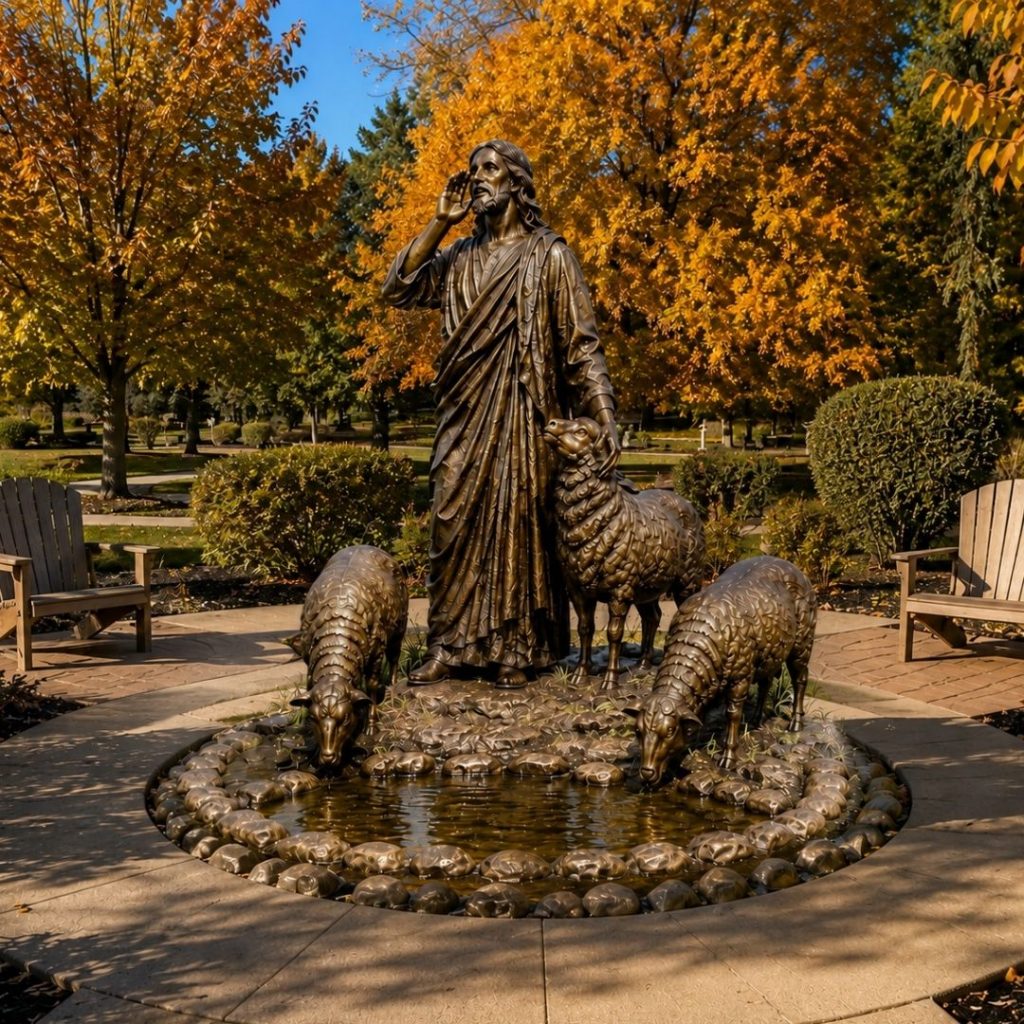
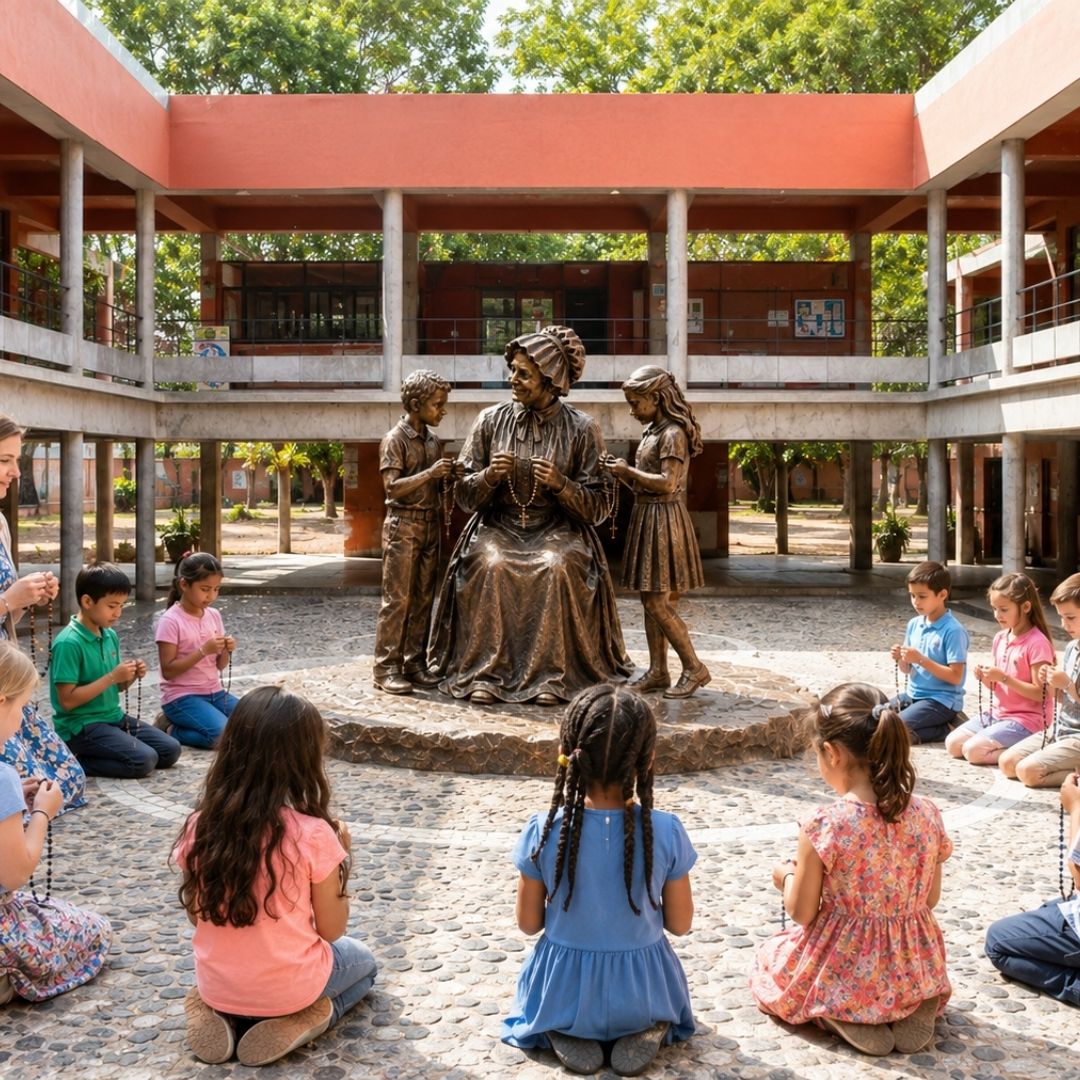
Circular pedestrian areas and nearby seating also change how long people remain with the artwork. Someone may initially approach simply to see the sculpture, then sit nearby for several minutes. A family may stop after Mass. A parishioner may use the space for prayer. Children may naturally be drawn toward the sheep and, through curiosity, begin asking questions about the story they represent.
This is where church beautification can become something deeper than beautification. The goal is not merely to improve an empty lawn. It is to create an environment capable of supporting prayer, conversation, catechesis, and encounter.
Sacred Art That Children Can Understand
The Good Shepherd has always been particularly accessible to children. A child does not need an advanced theological vocabulary to understand the essential relationship between a shepherd and a sheep.
- The sheep depends upon the shepherd.
- The shepherd protects it.
- If it wanders, he looks for it.
- When he calls, it follows.
That accessibility makes a Good Shepherd sculpture especially effective for parishes and Catholic schools. Adults can encounter sophisticated theological themes within the same artwork that a young child understands instinctively.
The physical environment strengthens that educational potential. Children can identify the different sheep, notice the water, observe Christ’s hands, and ask why one sheep is beside Him while others are farther away. Those questions provide natural opportunities for parents, teachers, catechists, and clergy to explain Scripture.
Good Catholic sculpture does not have to explain everything itself. Sometimes its most important role is encouraging someone to ask the first question.
Why Original Sacred Art Matters
There are many existing depictions of the Good Shepherd, and some are extraordinarily beautiful. Commissioning an original work is not valuable simply because it produces something different.
The value lies in intentionality.
A custom religious sculpture allows a parish or institution to ask what particular aspect of a familiar devotion it wants people to encounter. With the Good Shepherd, the emphasis might be protection, the lost sheep, pastoral care, still waters, Christ carrying the wounded, or—as in My Sheep Know My Voice—the intimate relationship between calling and recognition.
Once that central idea is established, decisions about gesture, composition, landscape, placement, and supporting elements can reinforce it.
That is a very different process from selecting a statue first and determining where to place it afterward.
The best religious sculpture design begins by asking what the artwork should communicate and then allowing the visual language to grow from that purpose.
Designing the Space Around Sacred Art
The Good Shepherd installation also offers a practical lesson for parish committees considering sacred art for churches: think beyond the sculpture footprint.
A committee may initially focus on the dimensions of the bronze and the size of its foundation. Yet the experience of the finished installation will also depend upon what happens ten, twenty, or even fifty feet away.
Where does the visitor first see the sculpture? What is behind it? How does someone approach it? Is there somewhere to sit? Will mature landscaping eventually obscure important sight lines? How does sunlight move through the site? Will the sculpture remain visible during winter? Could the space accommodate a small prayer group or religious education class?
These questions are especially important with outdoor sacred art because the site effectively becomes part of the composition.
A successful installation should feel as though the sculpture belongs precisely where it stands.
A Shepherd Who Is Still Calling
Perhaps the most compelling aspect of the Good Shepherd is that the image never really becomes outdated.
People still wander. They still experience fear and uncertainty. They still need reassurance that they are known rather than anonymous, sought rather than forgotten.
That is why Christ’s words continue to resonate: His sheep hear His voice. He knows them, and they follow Him.
My Sheep Know My Voice attempts to make that relationship visible. Christ calls outward while keeping one sheep close. Other sheep inhabit the landscape around Him. Water evokes restoration and peace. The surrounding environment gives visitors room to approach, remain, and reflect.
The sculpture is therefore not intended merely to show people what the Good Shepherd looks like. It asks them to consider something more personal:
Do I recognize His voice?
That is ultimately what sacred art can do at its best. It can take words Christians have heard many times and give them physical presence. It can transform an ordinary part of a church campus into a place where Scripture is encountered differently.
And sometimes, by giving people a place to stop long enough to look and listen, sacred art can help a familiar voice be heard again.
Considering a Custom Sculpture for Your Parish?
Every commission begins with a conversation about what your community wants people to encounter. If your parish, school, or institution is exploring an original work of sacred art—and the space that will surround it—we would welcome the opportunity to talk with you.